
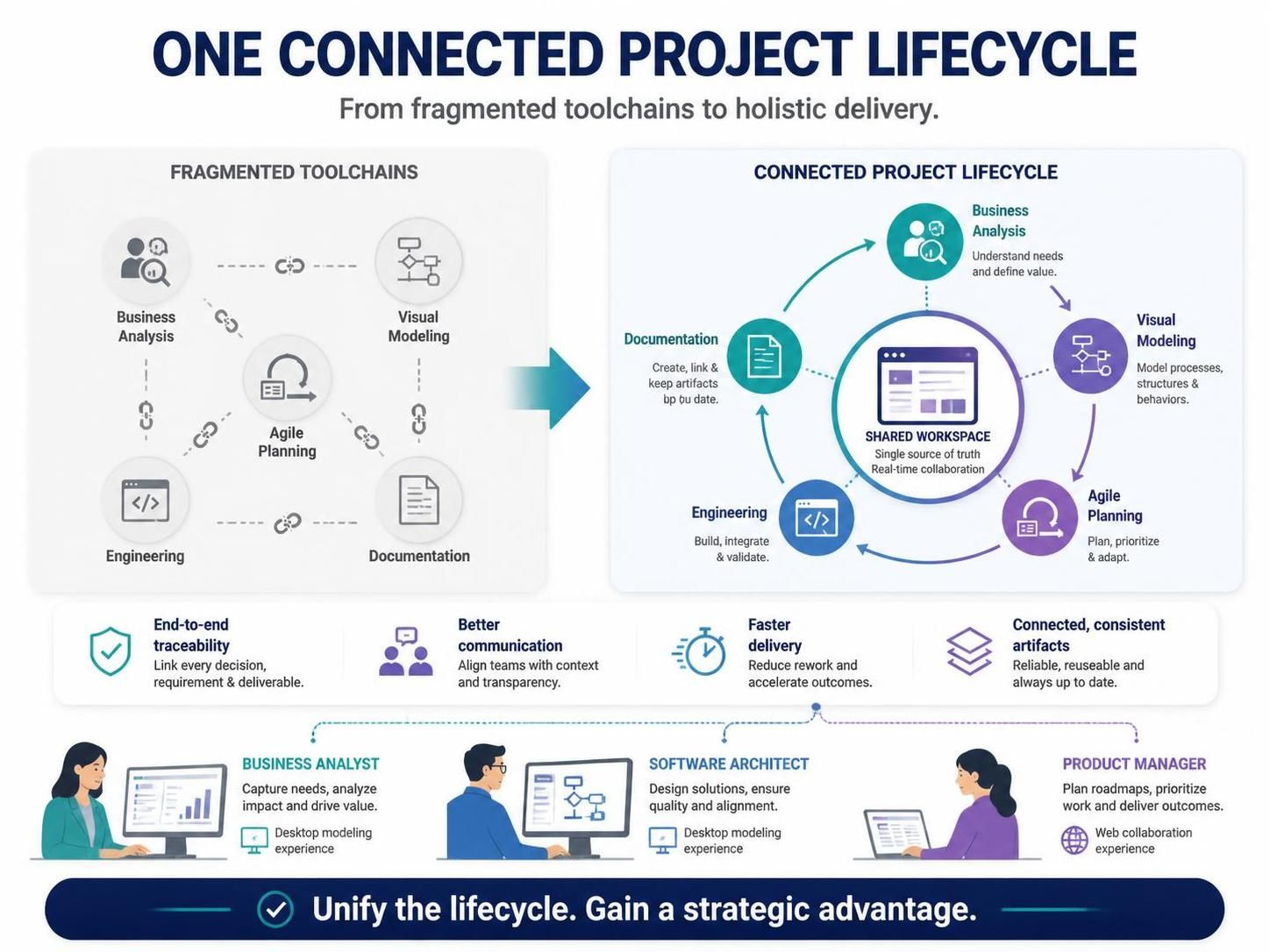
In the modern software development landscape, the traditional siloed approach to project management is rapidly becoming obsolete. The diagram One Connected Project Lifecycle illustrates a critical paradigm shift: moving from fragmented toolchains to a unified, holistic delivery model. This tutorial explores the system architecture behind this transformation, explaining how integrating Business Analysis, Visual Modeling, Agile Planning, and Engineering creates a “Single Source of Truth” for your organization.
The Problem: Fragmented Toolchains
Historically, teams have relied on a disjointed set of tools where each department operates in isolation. As depicted in the left side of the lifecycle diagram, the “Fragmented Toolchains” model suffers from broken connections:
- Business Analysis often operates in Word documents or spreadsheets, disconnected from technical design.
- Visual Modeling is frequently performed in standalone modeling tools that don’t sync with requirements.
- Agile Planning tools are often separate from the actual code repositories.
- Engineering and Documentation are treated as afterthoughts, leading to version control nightmares.
When these tools are not integrated, the result is a lack of traceability. A change in a requirement document may never reach the engineer, and a change in the code may never update the documentation. This friction leads to rework, misalignment, and slower delivery speeds.
The Solution: The Connected Project Lifecycle
The right side of the diagram introduces the Connected Project Lifecycle. This architecture is built around a central Shared Workspace. Instead of isolated islands of information, all project artifacts exist within a single ecosystem, ensuring that every decision is linked to every deliverable.
1. The Central Hub: Shared Workspace
At the core of this architecture is the concept of a Single Source of Truth. In a unified platform, the workspace is not just a file repository; it is a relational database of project intelligence. When you update a requirement, the system automatically updates the traceability matrix, the model, and the test cases linked to it.
2. The Four Pillars of Integration
The diagram highlights four specific domains that must be synchronized:
- Business Analysis: Focuses on understanding needs and defining value. In a connected lifecycle, these needs are immediately mapped to system capabilities.
- Visual Modeling: Moves beyond simple drawing to structural and behavioral definition. Models are not just diagrams; they are executable specifications that drive the system design.
- Agile Planning: This is the engine of prioritization. It connects high-level strategic goals to specific user stories and technical tasks, allowing teams to “Plan, Prioritize, and Adapt” in real-time.
- Engineering: The build and validation phase. In a connected system, code is validated against the original requirements, ensuring that the final product actually solves the problem identified in the Business Analysis phase.
3. The Outcome: Strategic Advantages
By unifying these pillars, the platform delivers four distinct advantages:
- End-to-end Traceability: You can link every decision to a requirement and every requirement to a deliverable.
- Better Communication: Teams align with context and transparency, eliminating the “guesswork” of what the next phase expects.
- Faster Delivery: Reducing rework by catching inconsistencies early accelerates the release cycle.
- Connected, Consistent Artifacts: Documentation is always up to date because it is generated from the models and code, not written separately.
Role-Based Flexibility
One of the most powerful aspects of this architecture is its ability to support diverse user roles without forcing a “one-size-fits-all” workflow. The diagram illustrates three key personas:
- The Business Analyst: Captures needs and analyzes impact. They utilize a desktop modeling experience to map complex processes and drive value.
- The Software Architect: Designs solutions and ensures quality. They require deep modeling capabilities to define scalable systems.
- The Product Manager: Plans roadmaps and prioritizes work. They often leverage web-based collaboration to manage high-level strategy and deliver outcomes.
Regardless of the role, the underlying data remains connected. A Product Manager can see how a priority change affects the Architect’s design and the Analyst’s process map instantly.
Conclusion
The shift from fragmented toolchains to a Connected Project Lifecycle is not merely a software upgrade; it is a strategic necessity. By unifying the project lifecycle, organizations gain a significant competitive advantage through speed, accuracy, and holistic visibility.