
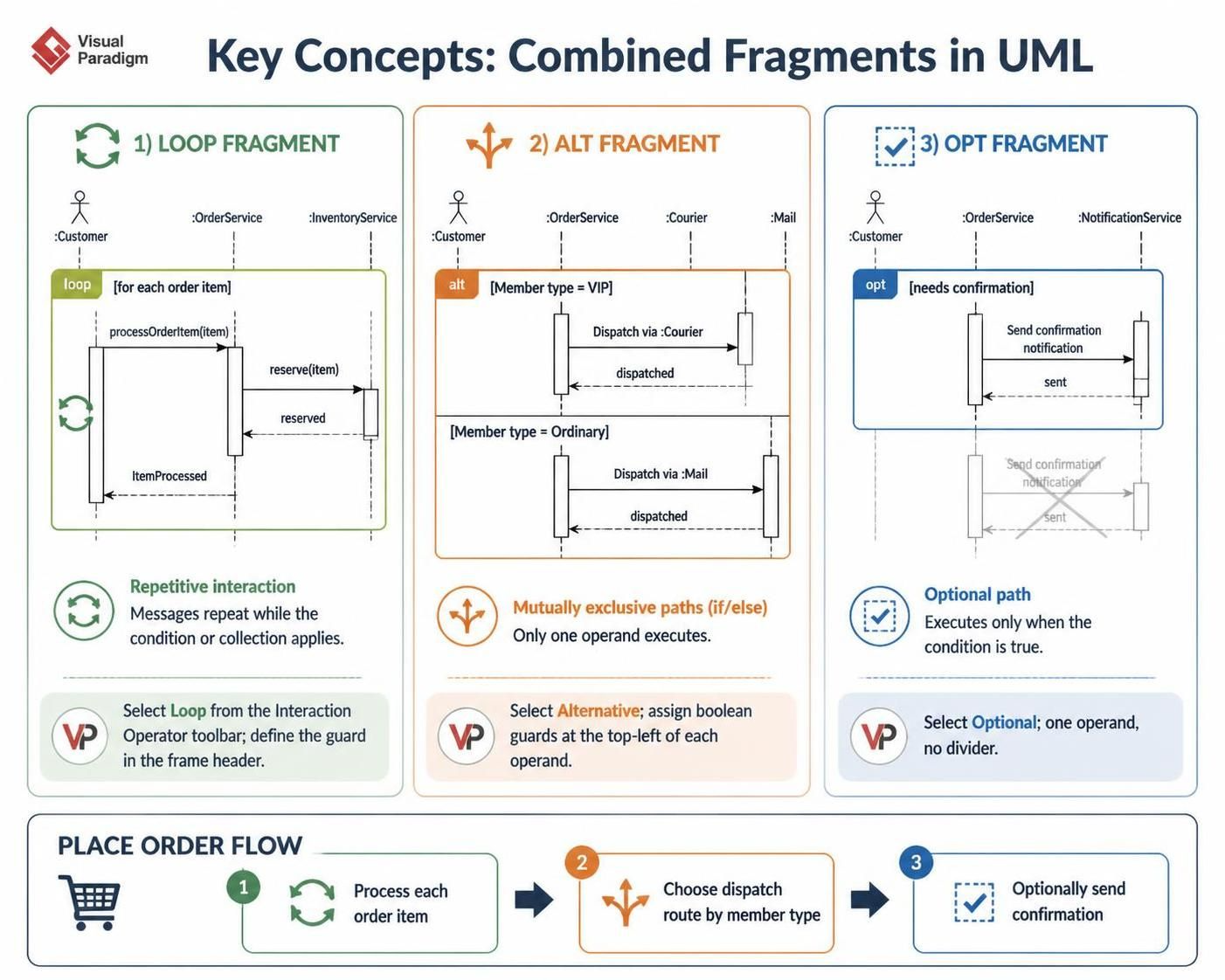
In the realm of software engineering, static diagrams often fail to capture the dynamic reality of business logic. Real-world systems rarely follow a single, linear path; they branch based on user roles, loop through data sets, and trigger optional events based on specific conditions. The “Place Order Scenario” serves as a perfect case study for modeling this complexity. This guide explores how to translate complex business rules—such as VIP versus Ordinary member handling—into clear, standardized UML Sequence Diagrams. We will focus specifically on leveraging Visual Paradigm to construct these interactions using Combined Fragments.
The Challenge of Dynamic Business Logic
When analyzing a “Place Order” system, developers encounter three distinct types of behavior that cannot be represented by simple linear message passing:
- Repetition: An order rarely consists of a single item. The system must process a collection of line items one by one.
- Decision Making: The system must determine the delivery method based on the customer’s membership status (VIP vs. Ordinary).
- Optionality: Not every transaction requires a confirmation notification; this is a conditional step.
To accurately model these behaviors in UML, we utilize Combined Fragments. These are the building blocks that define how messages are executed within a sequence diagram.
Deep Dive: The Three Essential Combined Fragments
In Visual Paradigm, these concepts are implemented as specific operators within the Interaction Operator toolbar. Let’s break down each fragment type.
1. The Loop Fragment (loop)
The loop fragment represents a repetitive interaction. It is essential when a message needs to be sent multiple times, usually to iterate over a collection of data.
- Definition: Messages inside this frame occur multiple times based on a specific condition or collection.
- Context: In the order system, the system must process each
order itemindividually before moving to the next stage. - Visual Paradigm Implementation:
- Select the Loop operator from the Interaction Operator toolbar.
- Wrap the relevant messages (e.g.,
processOrderItem(item)) inside the frame. - Define the guard condition in the header of the fragment. For example:
[for each order item].
2. The Alternative Fragment (alt)
The alt fragment represents mutually exclusive paths, effectively modeling If/Else logic. Only one operand within the alt frame will execute based on the evaluation of guard conditions.
- Definition: Represents a set of operands where exactly one is chosen based on the evaluation of guard conditions.
- Context: The system checks the
Member Type.- If
VIP: Dispatch via:Courier. - If
Ordinary: Dispatch via:Mail.
- If
- Visual Paradigm Implementation:
- Select the Alternative operator.
- Visual Paradigm automatically creates the dividing line between operands.
- Assign the boolean condition to the top-left corner of each operand section (e.g.,
[Member type = VIP]and[Member type = Ordinary]).
3. The Optional Fragment (opt)
The opt fragment represents a path that only executes if a specific condition is true. If the condition is false, the interaction simply skips this section entirely.
- Definition: Represents a path that is executed only if the condition is true.
- Context: Not every order requires a confirmation notification. This step only happens if
[needs confirmation]evaluates to true. - Visual Paradigm Implementation:
- Select the Optional operator.
- Unlike
alt, there is no dividing line; there is only one operand area containing the conditional logic.
Tooling: Visual Paradigm
While understanding the theoretical concepts of UML is crucial, the practical application requires a robust modeling tool. Visual Paradigm is a leading enterprise-grade modeling tool that excels in handling complex sequence diagrams.
Why Visual Paradigm for Combined Fragments?
Visual Paradigm provides a user-friendly interface that abstracts the complexity of UML syntax into visual drag-and-drop operations. When constructing the “Place Order” scenario, Visual Paradigm handles the following capabilities:
- Interaction Operator Toolbar: The tool provides dedicated buttons for
loop,alt, andopt, ensuring that diagrams adhere strictly to standard notation. - Guard Condition Management: It allows developers to easily edit the guard conditions (the text in square brackets) directly on the frame header without breaking the layout.
- Operand Organization: For
altfragments, Visual Paradigm automatically manages the layout and splitting of operands, ensuring that the “VIP” and “Ordinary” paths are visually distinct and readable.
By mastering these tools and concepts, developers and analysts can create documentation that bridges the gap between abstract requirements and concrete implementation logic.