
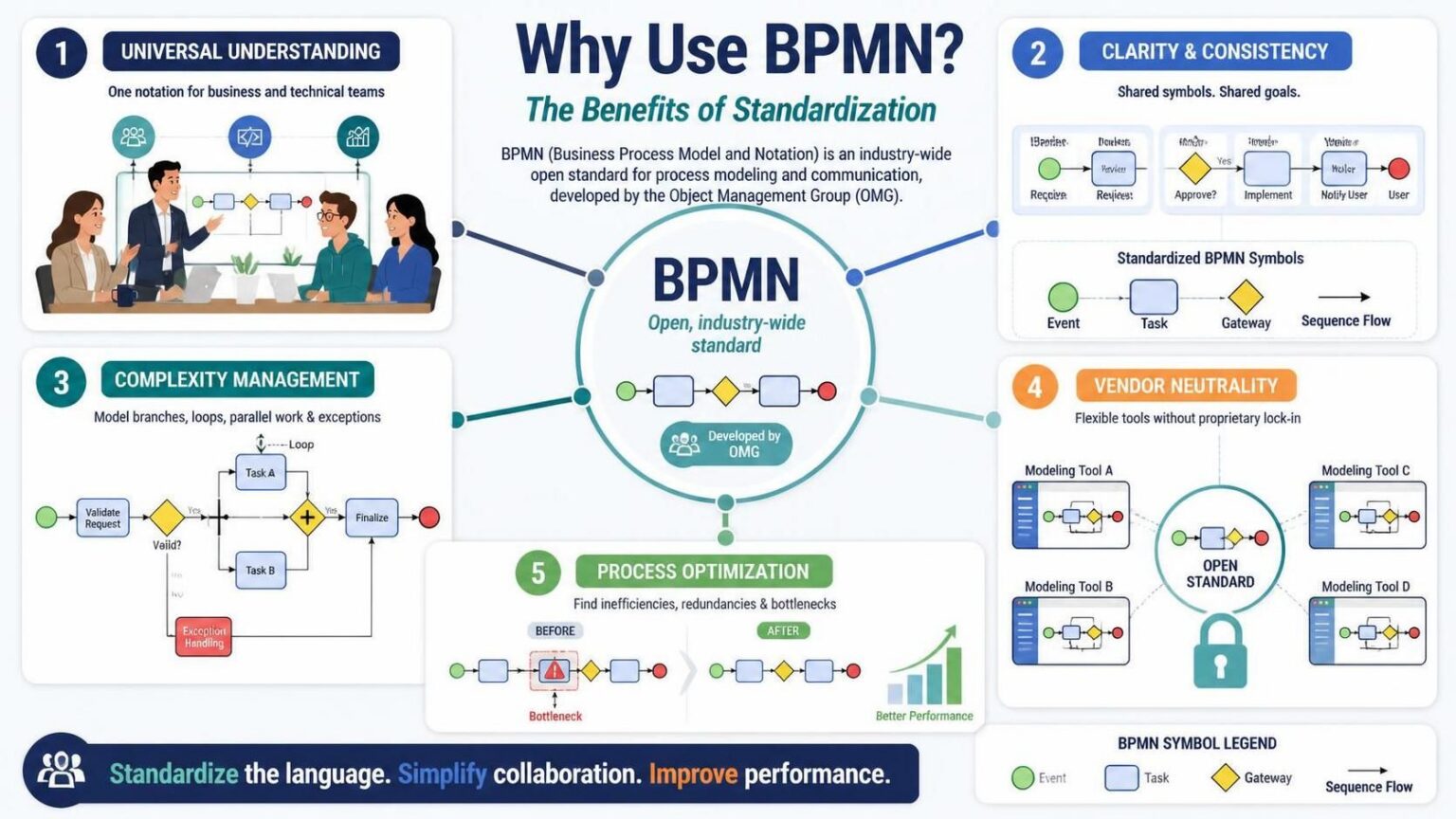
In the modern enterprise landscape, the gap between business strategy and technical execution is often where projects go wrong. Business stakeholders describe workflows in natural language, while developers interpret them through the lens of logic and constraints. This translation layer is fraught with ambiguity. Business Process Model and Notation (BPMN) was created to solve this exact problem. It is not merely a drawing tool; it is a standardized graphical language that bridges the divide between business processes and technical implementation.
This tutorial explores the core architecture of BPMN, its symbology, and how leveraging AI-assisted tools like Visual Paradigm can transform the way you document and optimize complex workflows.
1. The Architecture of Standardization
BPMN is developed by the Object Management Group (OMG) and serves as the industry-wide open standard. Its architecture is designed to be vendor-neutral, meaning a process diagram created in one tool can be opened and executed in another without losing fidelity. This prevents “tool lock-in” and ensures that your process documentation is a permanent asset, not just a temporary sketch.
The standard relies on a visual vocabulary that is intuitive enough for a business analyst to read but precise enough for a developer to implement. The core philosophy is Universal Understanding, ensuring that a “Task” or a “Gateway” means the same thing to a manager in New York as it does to a developer in Bangalore.
2. The Core Symbology: The Building Blocks
To model a process effectively, one must master the fundamental symbols. BPMN categorizes these into a few primary constructs:
Events (Circles)
Events represent something that happens during the course of a process. They are depicted as circles and affect the flow of the process.
- Start Event: The trigger that initiates the process (e.g., “Receive Order”).
- End Event: The conclusion of the process (e.g., “Order Shipped”).
- Intermediate Event: Something that happens in between, such as a message received or a timer expiration.
Tasks (Rounded Rectangles)
A task is the work performed in the process. It is the “meat” of the diagram. In BPMN, a task can be atomic (a single step) or a sub-process (a complex nested workflow).
Gateways (Diamonds)
Gateways control the divergence and convergence of the flow. They act as the decision-making logic of your diagram.
- Exclusive Gateway (XOR): “Either/Or.” The path splits, but only one path is taken (e.g., “Is the order valid? Yes OR No”).
- Inclusive Gateway (OR): “One or More.” Multiple paths can be taken simultaneously.
- Parallel Gateway (+): “AND.” The path splits into multiple parallel branches that must all complete before converging again.
3. Managing Complexity and Optimization
One of the greatest strengths of BPMN is its ability to handle Complexity Management. Unlike a simple flowchart, BPMN explicitly supports:
- Loops: Iterative actions.
- Parallel Work: Modeling simultaneous activities.
- Exception Handling: Clearly defining what happens when things go wrong.
By visualizing these elements, organizations can perform Process Optimization. You can identify bottlenecks (where work piles up), redundancies (duplicate tasks), and inefficiencies before a single line of code is written. The “Before” and “After” concepts in BPMN allow teams to simulate changes and measure potential improvements in performance.
4. Modern Modeling with AI and Visual Paradigm
Traditionally, creating these diagrams required deep knowledge of syntax and shape placement. However, modern tooling like Visual Paradigm integrates AI capabilities to streamline this workflow. Instead of manually dragging and dropping shapes, you can describe the process in plain text or a semi-structured format, and the AI generates the BPMN diagram.
This approach allows for rapid prototyping. You can focus on the logic and the business rules rather than the visual aesthetics of the drawing. The AI ensures that the resulting diagram adheres to the strict BPMN 2.0 standards, guaranteeing that the model is executable and analyzable.
Example: Modeling a Parallel Approval Workflow
Imagine a scenario where a project manager needs to submit a budget request that requires approval from both a Department Head and a Finance Lead. These approvals must happen simultaneously. Here is how you might conceptually model this logic using BPMN principles:
START_EVENT: "Budget Request Received"
    --> TASK: "Review Request"
    --> PARALLEL_GATEWAY: "Split Approvals"
        --> (Branch 1) TASK: "Dept. Head Review"
        --> (Branch 2) TASK: "Finance Lead Review"
    --> PARALLEL_GATEWAY: "Wait for Both"
    --> EXCLUSIVE_GATEWAY: "Approved by Both?"
        --> (Yes) TASK: "Release Budget"
        --> (No) TASK: "Reject Request"
END_EVENT: "Process Complete"
In a tool like Visual Paradigm, you would simply define the logic above, and the AI would render the parallel gateways and sequence flows automatically, ensuring the diagram is syntactically correct.
Conclusion
BPMN is more than just a notation; it is a strategic asset. By standardizing the language of business processes, organizations can reduce miscommunication, manage complexity, and optimize performance. Whether you are documenting current procedures or designing future workflows, understanding the core constructs of BPMN is the first step toward operational excellence.