
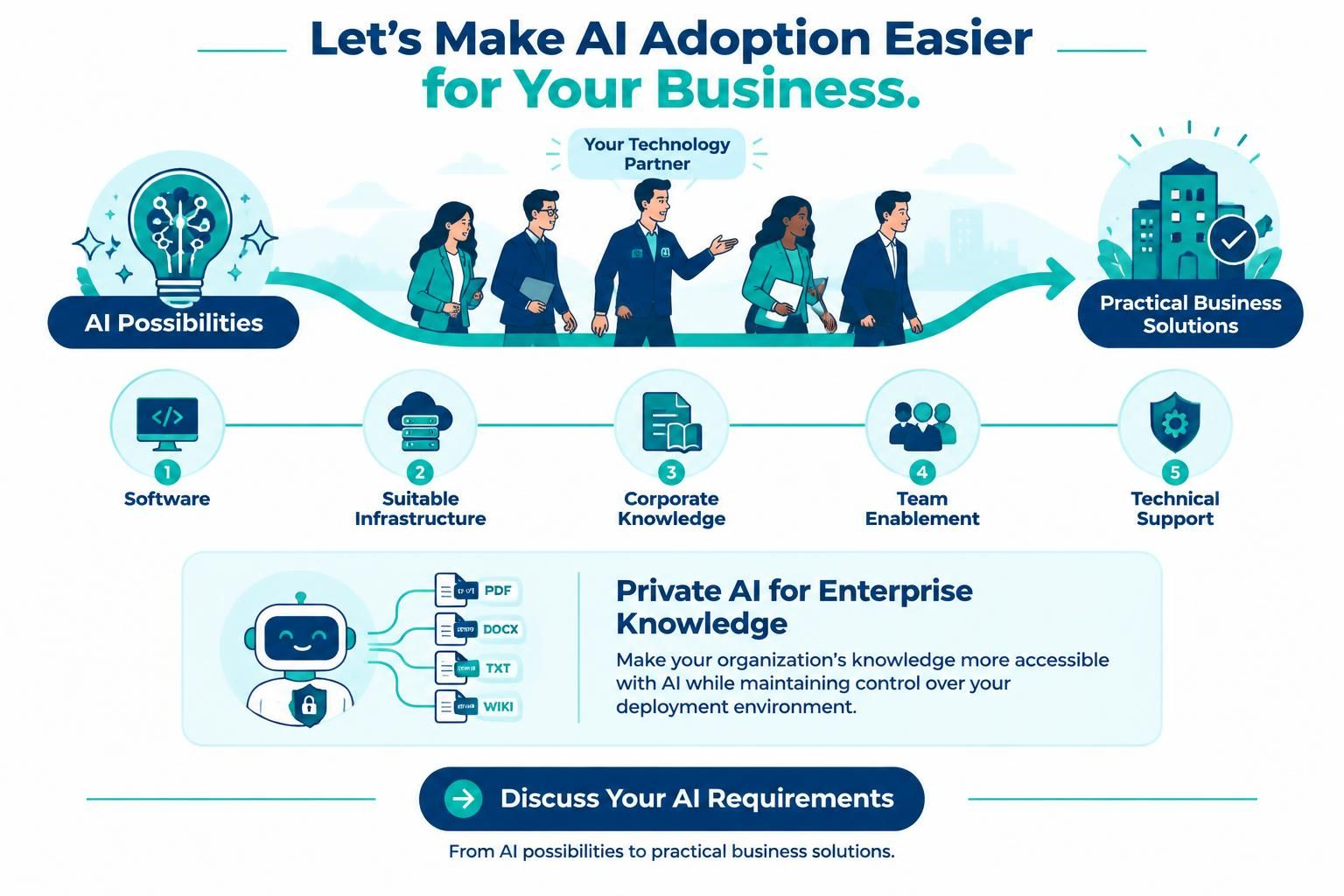
In the modern digital landscape, the gap between “AI Possibilities” and “Practical Business Solutions” is often bridged by a complex ecosystem of software, infrastructure, and human expertise. This tutorial deconstructs the strategic architecture of the Visual Paradigm Private AI solution, illustrating how organizations can move from theoretical potential to tangible operational value.
By analyzing the visual framework provided, we can identify a critical five-pillar architecture that ensures successful AI adoption. This is not merely about installing a model; it is about integrating a holistic system that respects data sovereignty, leverages internal knowledge, and empowers teams.
The Strategic Architecture of AI Adoption
The core philosophy presented in the visual framework is that AI cannot function in isolation. To transition from the abstract concept of “AI Possibilities” to concrete “Practical Business Solutions,” an organization must align five specific components. These components form a linear dependency chain where the failure of one element compromises the entire system.
1. Software (The Interface)
The journey begins with the software layer. This represents the user interface and the application logic that allows humans to interact with AI models. Without a robust software environment, even the most powerful AI remains inaccessible. In the context of Visual Paradigm, this software layer often integrates with existing workflows, providing a seamless experience rather than a disruptive new tool.
2. Suitable Infrastructure (The Foundation)
The second pillar is infrastructure. For businesses prioritizing security and data privacy, this often implies a self-hosted or private cloud environment. This architectural choice ensures that sensitive data never leaves the organization’s controlled perimeter. It is the engine room that hosts the models and processes the data securely.
3. Corporate Knowledge (The Intelligence)
This is the differentiator for enterprise-grade AI. Generic models are trained on public data, but they lack the specific “know-how” of your organization. The Corporate Knowledge component involves ingesting internal documents—such as PDFs, DOCX files, TXT documents, and Wiki entries—into a structured system. This allows the AI to function as a specialized assistant that understands your specific industry jargon, policies, and historical data.
4. Team Enablement (The Human Element)
Technology alone does not create value; people do. The “Team Enablement” stage focuses on training and upskilling. This involves teaching employees how to prompt effectively, how to validate AI outputs, and how to integrate AI tools into their daily tasks. It shifts the workforce mindset from fear of replacement to empowerment through augmentation.
5. Technical Support (The Sustainability)
Finally, the journey concludes with ongoing Technical Support. AI adoption is not a “set and forget” event. It requires maintenance, updates, and troubleshooting. A dedicated support structure ensures that the AI solution remains reliable and evolves alongside the business’s changing needs.
Visualizing the System Flow
To better understand how these components interact, we can model the system using a high-level data flow representation. This diagram illustrates the journey of a user query through the system, highlighting where data is processed and how knowledge is retrieved.
flowchart TD
    subgraph HumanLayer["Human Interaction Layer"]
        User((User))
        Team[Team Enablement]
    end

    subgraph InfrastructureLayer["Infrastructure & Software Layer"]
        Software[Software Interface]
        Infra[Private Infrastructure]
    end

    subgraph DataLayer["Corporate Knowledge Layer"]
        Doc1[PDF Files]
        Doc2[DOCX Files]
        Doc3[TXT Files]
        Wiki[Enterprise Wiki]
        VectorDB[(Vector Database)]
    end

    subgraph AIProcessing["AI Core Processing"]
        Model[AI Model]
        RAG[Retrieval Engine]
    end

    subgraph OutputLayer["Business Solution"]
        Answer((Answer))
        Decision[Business Decision]
    end

    User -->|Query| Software
    Software -->|Send Request| Infra
    Infra -->|Access| Model

    Team -->|Training| User

    Doc1 & Doc2 & Doc3 & Wiki -->|Ingest & Index| VectorDB
    Model -->|Query| RAG
    RAG -->|Retrieve Context| VectorDB

    Model -->|Generate Response| Answer
    Answer -->|Action| Decision
Decoding the Architecture
- Ingestion Pipeline: Notice how various document formats (PDF, DOCX, TXT, Wiki) feed into the Vector Database. This represents the “Corporate Knowledge” pillar, where unstructured data is converted into a format the AI can understand and search.
- The Retrieval Engine: The Retrieval Engine acts as a bridge. When the AI receives a query, it doesn’t just guess; it searches the Vector Database for relevant context. This ensures the answers are relevant to the specific business.
- The Feedback Loop: The “Team Enablement” component interacts with the user, ensuring that the human element is constantly refining how they interact with the system.
Conclusion: The Path Forward
The transition from AI Possibilities to Practical Business Solutions is a structured journey. By systematically addressing the five pillars—Software, Infrastructure, Corporate Knowledge, Team Enablement, and Technical Support—organizations can build a resilient AI ecosystem. Visual Paradigm’s Private AI solution exemplifies this approach, offering a secure, knowledge-driven platform that empowers businesses to innovate with confidence.
Whether you are exploring self-hosted AI or seeking a partner to guide your implementation, understanding this architecture is the first step toward unlocking the true potential of your enterprise data.