
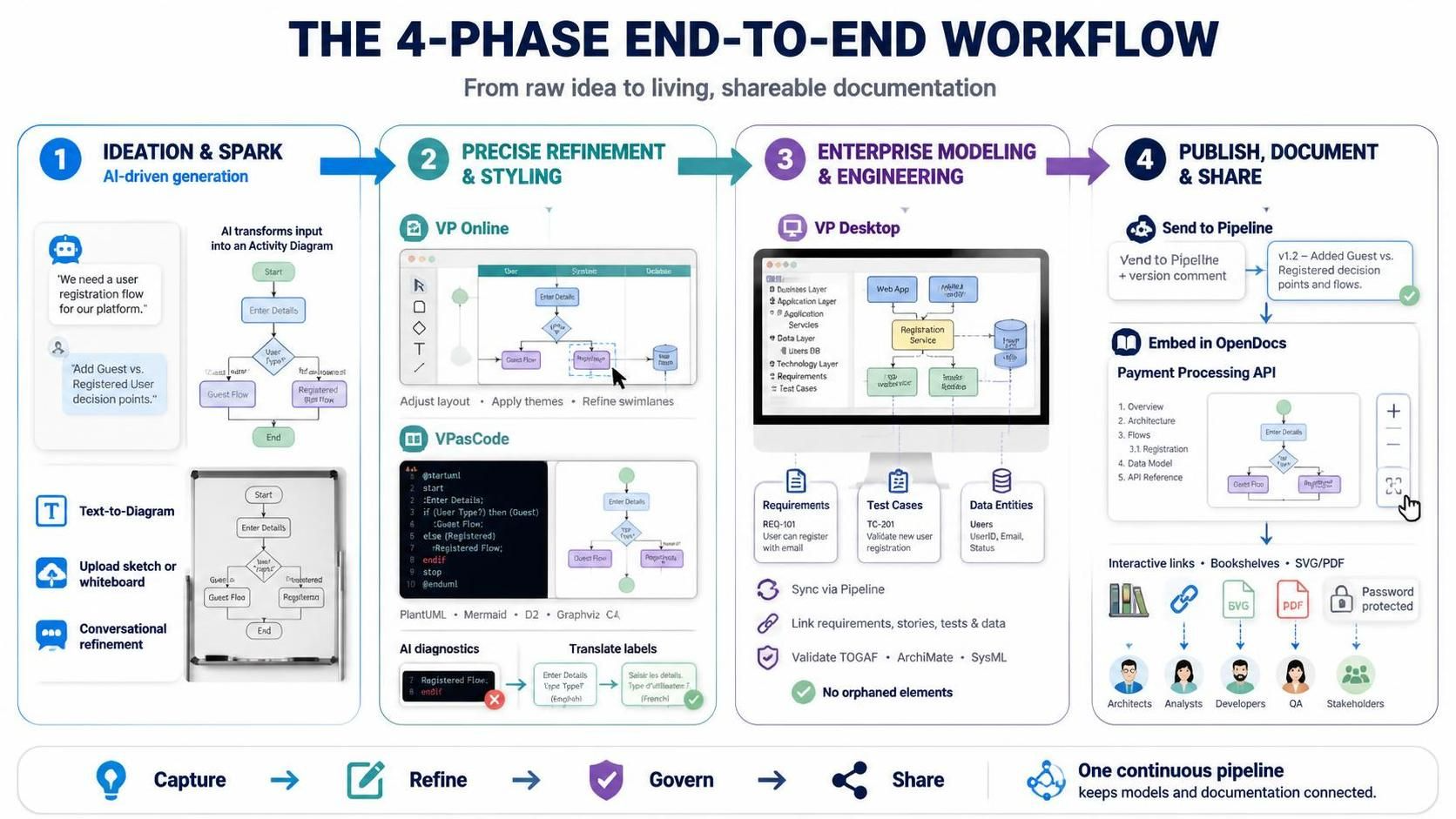
In the fast-paced world of software engineering and enterprise architecture, the gap between a fleeting idea and a concrete, executable specification can often lead to documentation rot or architectural drift. Visual Paradigm has addressed this by implementing a comprehensive 4-Phase End-to-End Workflow. This approach transforms the traditional, disjointed modeling process into a continuous, integrated pipeline—spanning from Capture to Refine, Govern, and finally Share.
This tutorial breaks down each phase of this workflow, demonstrating how to leverage AI-driven generation, precise coding-based refinement, and enterprise-grade engineering to create living documentation.
Phase 1: Ideation & Spark (AI-Driven Generation)
The journey begins with the Capture phase. In traditional modeling, capturing an idea requires manual setup of shapes, connecting lines, and alignment. Visual Paradigm revolutionizes this by integrating AI directly into the workflow to transform raw concepts into structured diagrams instantly.
Text-to-Diagram Capability
At the core of this phase is the ability to translate natural language into visual models. You do not need to know syntax or drag-and-drop mechanics. Instead, you can provide a prompt such as:
“We need a user registration flow for our platform.”
The system analyzes this intent and generates a preliminary Activity Diagram. This includes logical branching based on the context provided. For instance, if you specify a decision point between a “Guest” and a “Registered” user, the AI automatically structures the flow to handle these divergent paths.
Conversational Refinement & Sketching
This phase is not limited to text. It supports:
- Upload Sketches: Snap a photo of a whiteboard or napkin sketch, and the system recognizes the elements.
- Conversational Refinement: You can iterate on the AI’s output through chat, adding details like “Add Guest vs. Registered User decision points.”
Phase 2: Precise Refinement & Styling
Once the raw model is generated, it moves to the Refine phase. This is where “good enough” becomes “production ready.” The workflow supports two distinct environments for this refinement: the visual VP Online interface and the code-centric VPasCode editor.
Visual Styling in VP Online
For users who prefer a GUI, VP Online allows for rapid aesthetic adjustments. You can:
- Adjust Layout: Auto-arrange swimlanes and nodes for clarity.
- Apply Themes: Enforce corporate branding or specific industry standards.
- Refine Swimlanes: Organize processes by actor or system component.
Precision Engineering with VPasCode
For technical users and DevOps teams, the power lies in VPasCode. This feature bridges the gap between text-based modeling languages and visual representation. It supports industry-standard formats such as PlantUML, Mermaid, D2, and Graphviz CA.
By writing code, you ensure precision. Consider a logic flow for a registration service:
@startuml
start
:Enter Details;
if (User Type?) then (Guest)
  :Guest Flow;
else (Registered)
  :Registered Flow;
endif
stop
@enduml
This code snippet is not just a diagram; it is a version-controlled definition of the system logic. If the code changes, the diagram updates automatically. This approach eliminates the “manual diagramming” bottleneck and allows developers to document logic alongside their source code.
AI Diagnostics & Translation
The system also acts as a smart assistant during refinement. It can run AI diagnostics to catch errors (highlighting invalid syntax or orphaned elements) and even translate labels for international teams, converting English logic to French or other languages seamlessly.
Phase 3: Enterprise Modeling & Engineering
The Govern phase represents the transition from simple diagrams to robust engineering artifacts. Using the VP Desktop environment, the workflow integrates with the broader enterprise ecosystem.
The Architecture Layer
Enterprise models are no longer isolated islands. The system visualizes the Business Layer, Application Layer, Data Layer, and Technology Layer within a single view. This ensures that high-level requirements align with technical implementation.
Traceability & Validation
Crucially, this phase enforces data integrity through:
- Link Requirements, Stories, Tests & Data: Every element in the diagram can be linked to specific requirements (e.g., REQ-101) or test cases (e.g., TC-201).
- Validation Standards: The system validates models against industry standards like TOGAF, ArchiMate, and SysML, ensuring architectural compliance.
- No Orphaned Elements: The system ensures that every decision point has a defined outcome, preventing logical dead-ends.
Phase 4: Publish, Document & Share
The final phase, Share, ensures that the hard work of modeling translates into actionable documentation for the entire organization. This phase utilizes a continuous pipeline to push models to various stakeholders.
OpenDocs & Versioning
Models are published via a Pipeline system, allowing for robust version control (e.g., “v1.2 – Added Guest vs. Registered decision points”). This documentation can be embedded directly into OpenDocs, creating a central repository of truth.
Interactive & Multi-Format Output
The output is not static PDFs. The workflow generates:
- Interactive Links: Clickable diagrams that allow stakeholders to drill down into details.
- SVG/PDF Exports: High-fidelity assets for technical reports.
- Password Protection: Secure sharing of sensitive architectural data.
This ensures that Architects, Analysts, Developers, QA teams, and Stakeholders all receive the specific view of the system they need.
Summary of the Workflow
The 4-Phase End-to-End Workflow effectively creates a unified ecosystem:
- Capture: Generate models from text, sketches, or chat.
- Refine: Polish using visual tools or precise code editors.
- Govern: Integrate with enterprise standards and requirements management.
- Share: Publish to a living, interactive documentation ecosystem.
By following this continuous pipeline, teams can ensure that their documentation remains a living asset that evolves alongside their software.