
Creating a successful project requires more than just a timeline; it requires a comprehensive understanding of the work itself. The Work Breakdown Structure (WBS) is the fundamental tool used to achieve this. It transforms a complex project goal into a manageable hierarchy of deliverables. In this tutorial, we will dissect the architecture of a standard project WBS, analyzing how high-level phases are decomposed into actionable work packages using the Visual Paradigm ecosystem.
Understanding the WBS Hierarchy
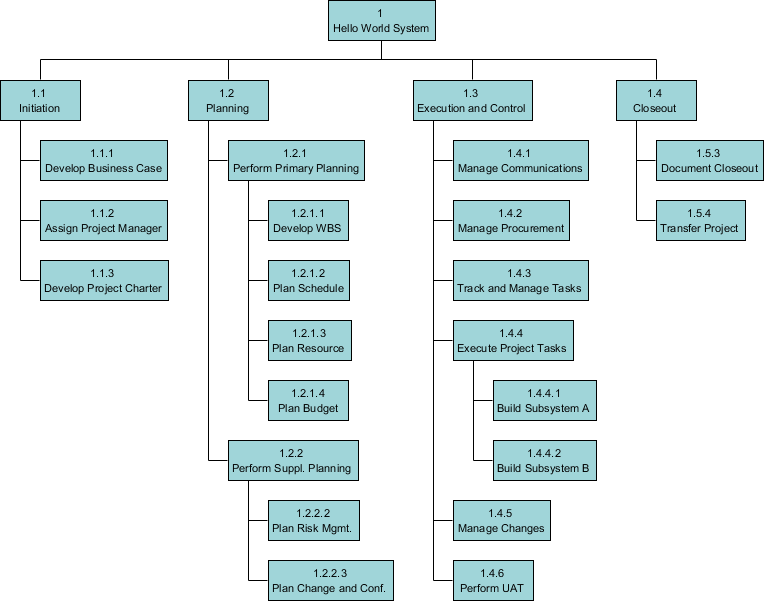
The image provided illustrates a classic Project Management WBS. Unlike a linear list, a WBS is a tree structure that breaks down the total scope of work. The structure in the diagram follows a strict logic:
- Level 1 (The Root): This represents the entire project, labeled here as “Hello World System.”
- Level 2 (The Phases): These are the major outcomes or phases of the project. In this example, the project is divided into four standard lifecycle phases: Initiation, Planning, Execution and Control, and Closeout.
- Level 3 and Below (Deliverables): These nodes break down the phases into specific products or services. For instance, under 1.2 Planning, we see the decomposition into “Perform Primary Planning” and “Perform Suppl. Planning.”
- Work Packages: The lowest level of the hierarchy (e.g., 1.4.4.1 Build Subsystem A) represents the “work package.” This is the smallest unit of work that can be estimated, assigned, and monitored.
This structure adheres to the 100% Rule, a critical principle in project management. It states that the sum of the work at the child level must equal 100% of the work represented by the parent level. If a task is missing from the WBS, the project scope is incomplete.
Decomposing the Project Lifecycle
Let’s examine the specific components shown in the diagram to understand how scope is managed.
1. The Initiation Phase (1.1)
The project begins with defining the “what” and “who.” The WBS branches into 1.1.1 Develop Business Case, which justifies the project’s existence. It then moves to 1.1.2 Assign Project Manager to establish authority, and finally 1.1.3 Develop Project Charter, the document that formally authorizes the project.
2. The Planning Phase (1.2)
This is often the most granular part of the WBS. It is split into two main streams: 1.2.1 Perform Primary Planning and 1.2.2 Perform Suppl. Planning.
Under Primary Planning, you can see the critical “iron triangle” constraints being defined: 1.2.1.2 Plan Schedule, 1.2.1.3 Plan Resource, and 1.2.1.4 Plan Budget. This ensures that time, money, and manpower are allocated before execution begins.
3. Execution and Control (1.3)
This phase represents the actual work of building the system. It includes 1.3.4 Execute Project Tasks, which is further broken down into subsystems (A and B). Notice 1.3.6 Perform UAT (User Acceptance Testing). This is a crucial detail; the WBS explicitly includes the testing phase, ensuring quality is not an afterthought but a planned deliverable.
4. Closeout (1.4)
The project is not finished until it is closed. The WBS includes 1.4.1 Manage Communications and 1.5.3 Document Closeout. This ensures all stakeholders are informed and the final product is formally handed over.
Applying the “Measurable” Characteristic
The text provided highlights that a good WBS must be Measurable. Looking at the diagram, we can see this characteristic in action. Every box represents a distinct outcome. You cannot “manage” a vague concept like “Planning,” but you can measure the completion of 1.2.1.2 Plan Schedule. Once the schedule is created and approved, the work package is 100% complete.
Visualizing with Visual Paradigm
Tools like Visual Paradigm allow teams to move beyond static images. By using the VPasCode tool or AI Chartbot, teams can define the WBS logic via code or natural language prompts. This approach ensures that the WBS remains a dynamic, living document that updates automatically as the project scope changes, rather than a static drawing that requires manual redrawing.
By structuring the project into these clear, hierarchical deliverables, the project team creates a roadmap that is both comprehensive and manageable, laying the foundation for successful project execution.