
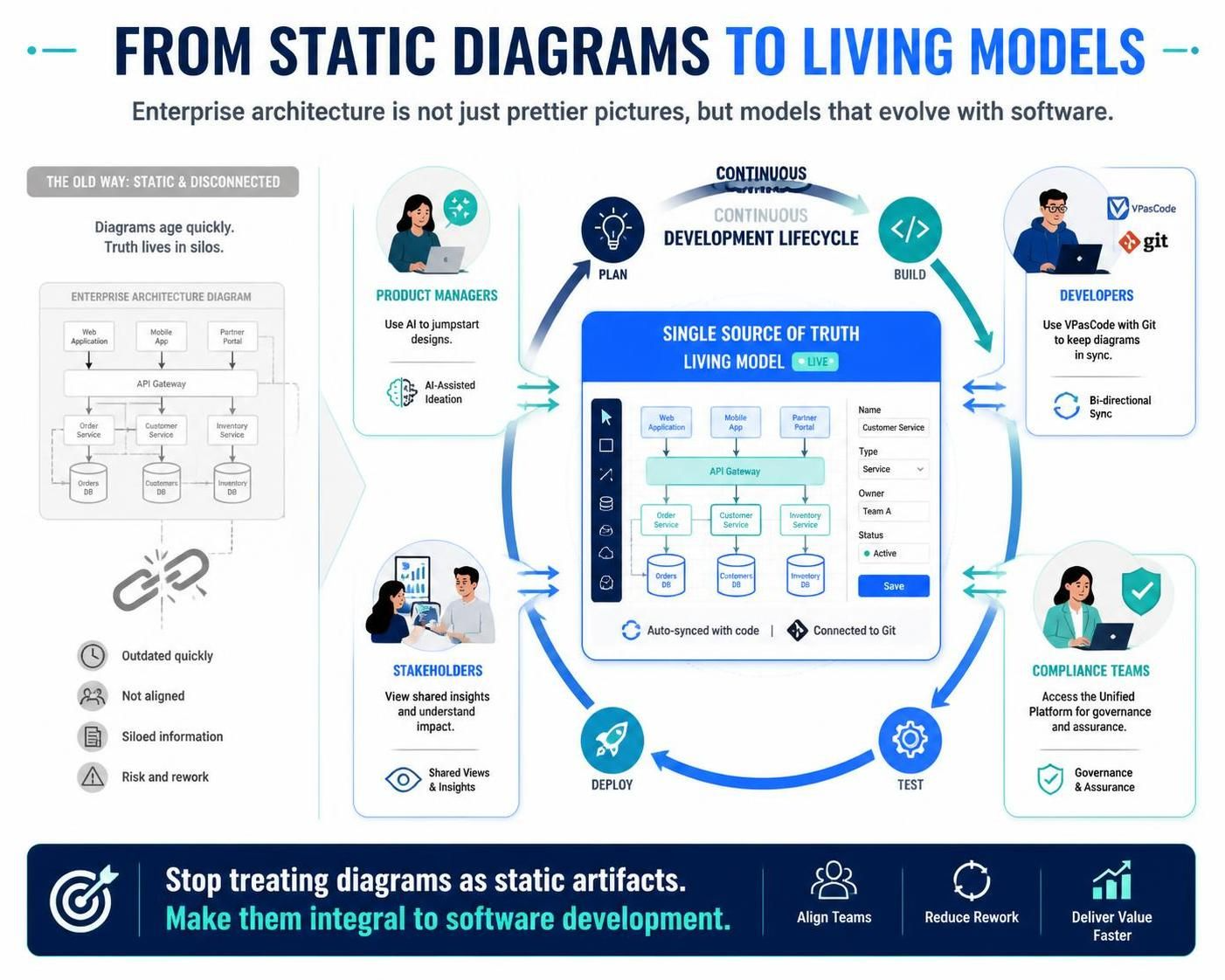
The evolution of Enterprise Architecture (EA) has moved beyond the era of static documentation. The traditional approach, often characterized by “beautiful pictures” that age quickly and live in silos, is no longer sufficient for modern software delivery. This tutorial explores how organizations can transition to “Living Models” using the Visual Paradigm ecosystem, specifically leveraging VPasCode and the Unified Platform to create a Single Source of Truth.
1. The Paradigm Shift: Static vs. Dynamic
Historically, architects created diagrams that represented the system at a specific point in time. Once the code changed, the diagram became obsolete. This disconnection leads to outdated information, misalignment between teams, and significant rework.
In the new model, diagrams are dynamic artifacts. They are not just documentation; they are integral parts of the development lifecycle. The goal is to ensure that the model evolves alongside the software, ensuring that the “Source of Truth” is always current.
2. The Continuous Development Lifecycle
The core of this ecosystem is the Continuous Development Lifecycle, which connects four key roles. Each role interacts with the “Living Model” differently, contributing to a unified workflow.
Plan: AI-Assisted Ideation for Product Managers
The lifecycle begins with the Product Managers. In the past, this phase involved lengthy requirements gathering that might not be captured accurately in diagrams immediately. Today, AI is leveraged to jumpstart designs. This allows Product Managers to move from abstract ideas to concrete architectural concepts rapidly, setting the stage for the development team.
Build: Bi-Directional Sync with VPasCode
For Developers, the “Living Model” is the central hub. The diagram is not just a visual representation but is bi-directionally synchronized with the actual code repository (Git). This is achieved through VPasCode.
When a developer modifies the code, the diagram updates automatically. Conversely, if a change is made to the model, it can be propagated back to the codebase. This eliminates the “documentation lag” that plagues traditional Agile workflows.
Test & Deploy: Governance and Assurance
As the software moves to the Testing and Deployment phases, the focus shifts to Compliance Teams. Using the Unified Platform, these teams can access the model to perform governance and assurance checks. They verify that the architectural integrity is maintained and that the system meets regulatory standards without needing to read through raw code.
3. Technical Implementation: The VPasCode Workflow
To achieve this level of synchronization, Visual Paradigm utilizes a workflow that integrates directly with Git. The system acts as a bridge between the visual modeling environment and the version control system.
The following workflow illustrates how the model is kept in sync:
- Connect to Git: The developer initializes a connection between Visual Paradigm and their Git repository.
- Generate/Update Diagrams: As code is written, VPasCode reads the structure and updates the diagrams to reflect the current state.
- Visual Validation: The team reviews the “Living Model” to ensure architectural patterns are maintained.
- Commit & Sync: Changes are committed to Git, ensuring the code and the model remain perfectly aligned.
4. The Unified Platform: Shared Insights
Finally, the ecosystem ensures that Stakeholders are not left out. Through the Unified Platform, insights are shared across the organization. Stakeholders can view the architecture, understand the impact of changes, and see the real-time status of the project without needing deep technical knowledge of the codebase.
Summary of Benefits
- Align Teams: Breaks down silos between Product, Dev, and Compliance.
- Reduce Rework: Eliminates the need to manually update diagrams after code changes.
- Deliver Value Faster: Accelerates the development lifecycle by automating the synchronization of artifacts.
By adopting this approach, organizations stop treating diagrams as static artifacts and start treating them as dynamic, living models that drive value throughout the software development lifecycle.