
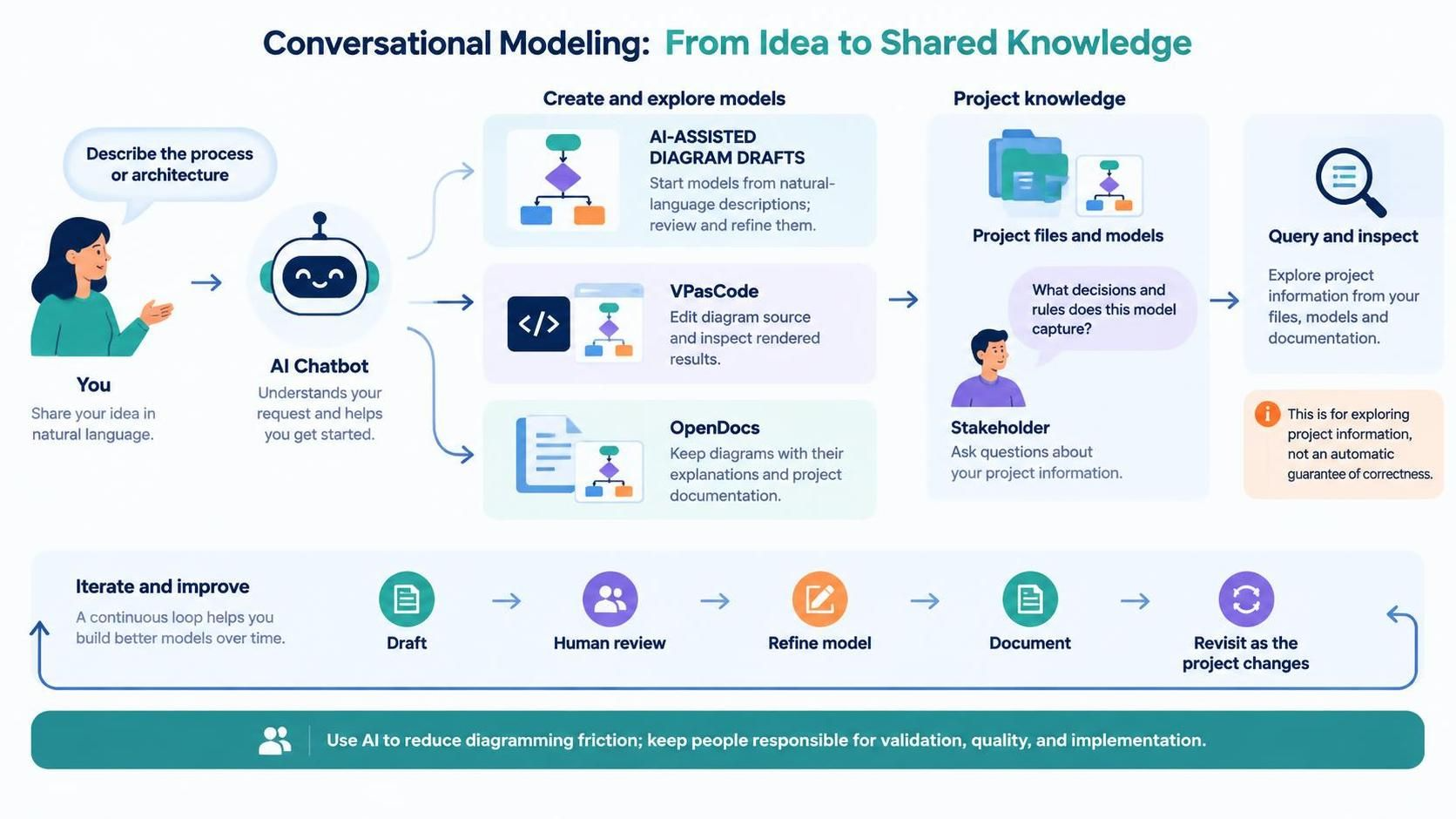
In the modern landscape of software architecture and business process management, the traditional “drag-and-drop” methodology is being challenged by a more intuitive paradigm: Conversational Modeling. Visual Paradigm’s AI ecosystem, specifically the integration of the AI Chatbot, VPasCode, and OpenDocs, represents a fundamental shift in how teams interact with complex system data. This tutorial explores the architecture of this workflow, demonstrating how to move from a simple natural language idea to a fully integrated, queryable knowledge base.
The Architecture of Conversational Modeling
The core philosophy behind this ecosystem is to lower the barrier to entry for technical modeling. By allowing users to “describe the process or architecture” in natural language, the AI Chatbot acts as the initial interpreter. It translates abstract human concepts into precise, standards-compliant models. This process is not a one-time event but a continuous loop that integrates creation, inspection, and documentation.
Phase 1: Creation and Exploration
The journey begins when a user interacts with the AI Chatbot. Instead of navigating complex toolbars, the user simply shares an idea. The system then branches into three distinct but interconnected pathways for model creation:
- AI-Assisted Diagram Drafts: This is the visual engine. When a user describes a process, the AI generates the initial diagrammatic representation. This allows for rapid prototyping where the user can review and refine the visual output immediately.
- VPasCode: For users who prefer precision or need to audit the underlying logic, VPasCode provides a code-level view. This acts as a bridge between the visual model and the machine-readable source code, allowing for direct edits to the diagram source.
- OpenDocs: Modeling is often incomplete without explanation. OpenDocs automatically associates the visual model with its corresponding documentation, ensuring that the diagram and the text description remain synchronized.
Phase 2: Turning Static Files into Knowledge Bases
Once the models are created, they often become static artifacts stored in project files. The ecosystem transforms these files into dynamic assets through the Project Knowledge module. This component allows stakeholders to query the project directly. Instead of manually navigating a complex diagram to find a specific rule or decision, a user can ask a question about the project information.
This capability is vital for “Query and Inspect” workflows. It allows architects and product managers to validate business logic without needing to understand the nuances of the diagramming syntax. The system acts as an intelligent layer that sits on top of the data, making the information accessible through natural language queries.
Phase 3: The Iterative Improvement Loop
The diagram illustrates a continuous loop labeled “Iterate and Improve.” This is crucial for maintaining model integrity over time. The workflow follows a specific sequence:
- Draft: The initial model is generated via AI.
- Human Review: Stakeholders validate the logic and accuracy.
- Refine Model: Adjustments are made based on feedback.
- Document: The final state is documented and stored.
- Revisit: As the project changes, the loop restarts, ensuring the models remain relevant.
Why This Matters for Agile Teams
The shift to conversational modeling addresses several critical pain points in software development:
- Reducing Technical Debt: By ensuring that documentation (OpenDocs) is generated alongside the model, teams avoid the common pitfall of documentation lagging behind implementation.
- Accelerated Design: The ability to translate ideas into visual models instantly speeds up the initial design phase, allowing for faster feedback loops.
- Bridging the Gap: It serves as a universal translator between abstract concepts and concrete implementation, fostering clearer communication between business stakeholders and technical developers.
In conclusion, Visual Paradigm’s AI ecosystem does more than just automate drawing; it fosters a culture where the mechanics of modeling take a backseat to the logic of solving complex problems. By keeping design, implementation, and documentation in perfect sync, teams can focus on delivering value rather than managing tools.