
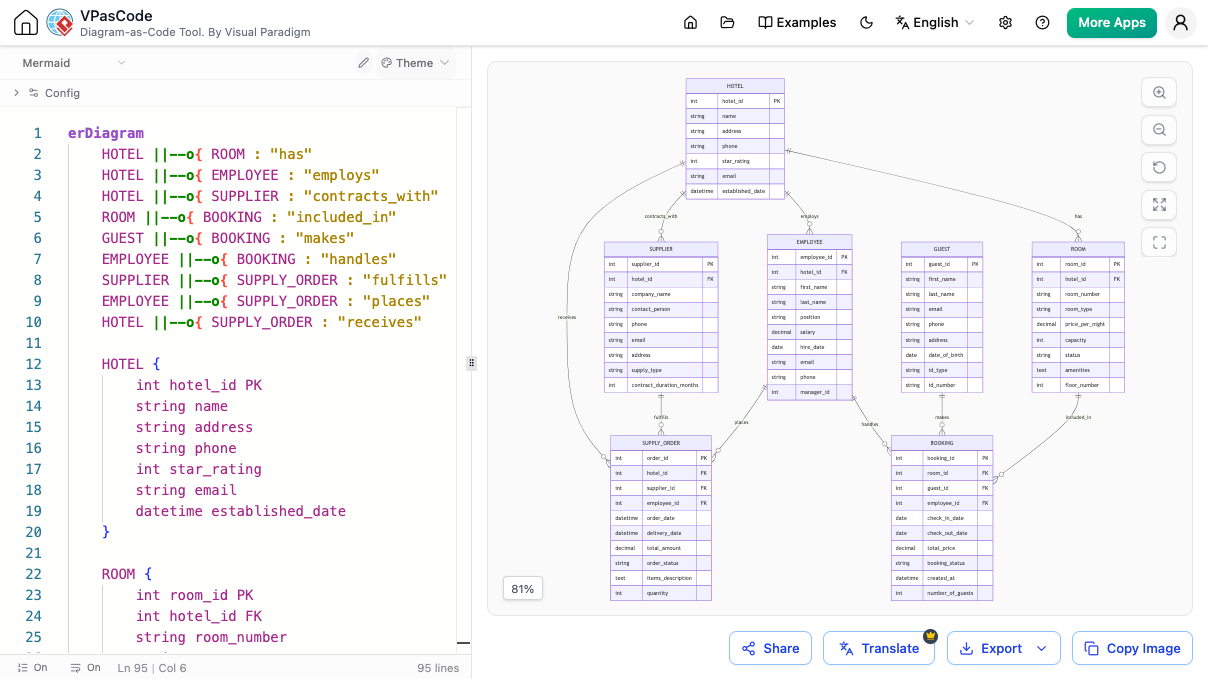
Welcome to this comprehensive guide on Entity-Relationship Diagrams (ERD) and database modeling. In the world of software architecture, few tools are as critical for visualizing data structures as the Entity-Relationship model. Today, we are diving deep into a complex Hotel Management system, demonstrating how to use Visual Paradigm’s VPasCode tool to define entities, relationships, and attributes using a concise, code-based syntax.
This tutorial will walk you through the specific syntax used to generate a robust database schema, explaining the “why” and “how” behind every line of code. Whether you are a database architect or a student learning system modeling, understanding the mapping between code and the resulting diagram is essential.
Understanding the Building Blocks: Entities and Attributes
At the heart of any ERD is the Entity, which represents a real-world object or concept—like a “Customer,” “Hotel,” or “Booking.” In the VPasCode syntax, we define these entities using a block structure. Let’s look at the ROOM entity as our first example:
ROOM {
    int number
    string type
}
Here, we are defining a table named ROOM. The lines inside the block represent the attributes (columns) of that table. Notice how we specify the data type alongside the attribute name:
int number: The room number is an integer.string type: The room type (e.g., “Deluxe”, “Suite”) is text.
When the VPasCode engine parses this, it automatically generates a database table structure with these specific fields, ensuring that the data integrity is maintained by enforcing these types.
Mapping Relationships: The Power of Cardinality
Entities rarely exist in isolation. They interact with one another through Relationships. In our hotel scenario, a single Hotel can have many Rooms, but a Room belongs to only one Hotel. This is a “One-to-Many” relationship.
In the VPasCode syntax, we express these connections using a specific notation involving pipes (|) and crow’s feet ({). Look at this relationship definition:
HOTEL ||--o{ ROOM : hasLet’s break down the syntax to understand the data model logic:
HOTEL: The “parent” or “one” side of the relationship.ROOM: The “child” or “many” side.:: The colon acts as a separator before the relationship label.: has: This is the semantic label describing the relationship.
The arrow notation ||--o{ is the visual representation of the cardinality:
- ||: Represents the “Mandatory One” side (The Hotel must exist).
- –o{: Represents the “Optional Many” side (A Room may exist, and there can be many).
When you write HOTEL ||--o{ ROOM : has, the VPasCode tool visualizes this as a line connecting the two tables, with a crow’s foot symbol on the ROOM side, indicating that one hotel can manage multiple room records.
Advanced Modeling: Complex Relationships
A real-world hotel management system is more complex than just hotels and rooms. It involves guests, bookings, employees, and suppliers. The VPasCode tool handles these complex many-to-many or one-to-many relationships gracefully.
Consider the BOOKING entity, which is central to the operation. It connects to multiple other entities:
CUSTOMER ||--o{ BOOKING : places
ROOM ||--o{ BOOKING : reserved by
EMPLOYEE ||--o{ BOOKING : handles
In this snippet, the BOOKING entity acts as a junction or a child entity that aggregates data from three different parents:
- A CUSTOMER places a booking.
- A ROOM is reserved by that booking.
- An EMPLOYEE handles the booking process.
This syntax allows you to define the entire database schema in a linear, text-based format, which is incredibly efficient for version control and rapid prototyping. Instead of dragging and dropping boxes in a GUI, you are writing the logic of your data structure directly.
Best Practices in ERD Modeling
When constructing these diagrams, consistency is key. Always ensure that your relationship labels (the text after the colon) are active verbs or nouns that make sense in the domain context. For instance, “has” is generic, but “reserved by” adds specific context to the relationship between a Room and a Booking.
Furthermore, pay attention to the data types. Mixing int and string incorrectly can lead to database errors later in the development lifecycle. The VPasCode tool helps visualize these constraints immediately, allowing you to refactor your code before generating the final SQL scripts.
Conclusion
By mastering the syntax of VPasCode, you gain the ability to visualize complex database architectures with speed and precision. The Hotel Management ERD we explored today serves as a perfect example of how to structure relationships between guests, inventory, and staff. As you move forward in your system design journey, remember that the code you write is the blueprint of your application’s data backbone.