
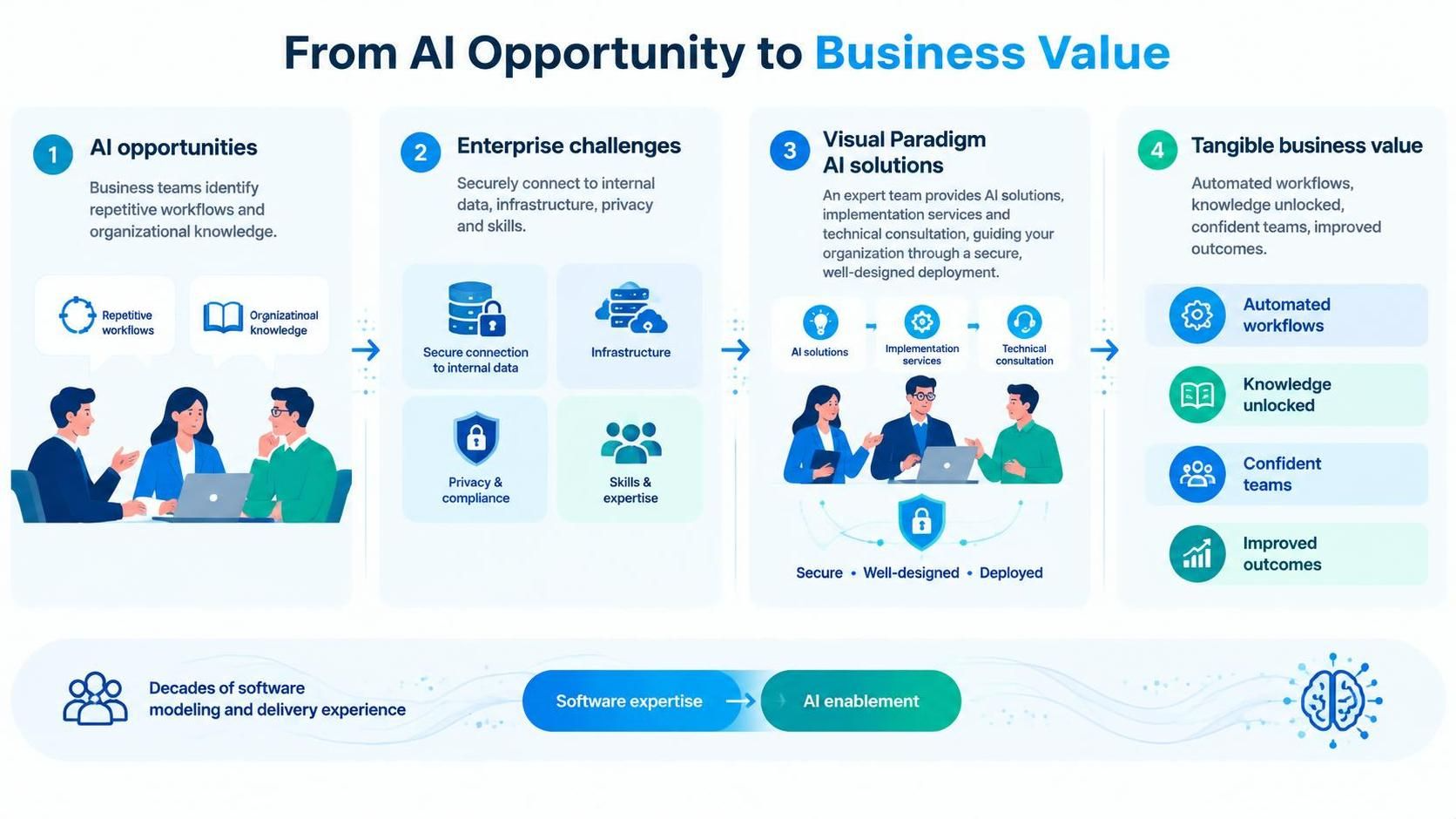
In the modern digital landscape, Artificial Intelligence (AI) has transitioned from a futuristic concept to a critical operational imperative. However, the gap between identifying an AI opportunity and realizing tangible business value is often where organizations falter. Visual Paradigm’s ecosystem addresses this gap through a comprehensive approach that leverages decades of software modeling expertise to facilitate a secure, self-hosted AI transformation.
Phase 1: Identifying AI Opportunities
The journey begins not with code, but with business strategy. Before selecting a model or a tool, enterprises must identify where AI can generate the highest return. This phase focuses on two primary vectors:
- Repetitive Workflows: These are the routine, high-volume tasks that drain human productivity. AI excels at automating these processes, freeing up human capital for higher-order thinking.
- Organizational Knowledge: Companies sit on mountains of unstructured data—documents, emails, and legacy files. Unlocking this “hidden value” allows for data-driven decision-making that was previously impossible.
At this stage, the goal is to map out the current state of the business and pinpoint specific areas where intelligent automation or knowledge retrieval can provide immediate relief.
Phase 2: Navigating Enterprise Challenges
Once an opportunity is identified, the conversation inevitably shifts to implementation barriers. For large enterprises, the “Black Box” nature of public cloud AI often poses unacceptable risks. The primary challenges that must be addressed include:
- Secure Connection to Internal Data: How do you feed proprietary data into an AI engine without exposing it to external risks?
- Infrastructure: Does the organization have the necessary compute resources, or does it need a scalable cloud architecture?
- Privacy & Compliance: Adhering to regulations like GDPR or HIPAA is non-negotiable. Data sovereignty is a key concern.
- Skills & Expertise: There is a global shortage of AI talent. How can a team leverage existing software engineering skills to manage AI deployments?
Phase 3: The Visual Paradigm AI Solution
To overcome these hurdles, Visual Paradigm offers a Self-Hosted AI Total Solution. This approach moves beyond simple tooling to provide a complete ecosystem for implementation and consultation. The solution is designed to be secure, well-designed, and fully deployed within the enterprise’s own environment.
The core pillars of this solution include:
- AI Solutions: Tailored strategies to integrate AI into existing workflows.
- Implementation Services: Expert guidance to handle the technical heavy lifting of deployment.
- Technical Consultation: Ongoing support to ensure the architecture scales and evolves.
This ecosystem eliminates the need for “data exfiltration” (sending data to public clouds) by allowing for local, private AI models that run securely on-premise or within a private cloud.
Phase 4: Realizing Tangible Business Value
The ultimate metric of success is not the complexity of the model, but the business outcomes it drives. By successfully navigating the previous phases, organizations achieve:
- Automated Workflows: Drastic reductions in time spent on manual processing.
- Knowledge Unlocked: Instant retrieval of critical information from vast document repositories.
- Confident Teams: Employees empowered by AI tools rather than replaced by them.
- Improved Outcomes: Better decisions, faster delivery, and optimized operations.
Conclusion
Visual Paradigm represents the logical evolution of software modeling tools into full-spectrum AI enablement. By combining decades of experience in system design with cutting-edge AI capabilities, they provide a roadmap for enterprises to adopt AI securely and effectively. This is not just about adopting new technology; it is about transforming the business architecture to support a future of intelligent automation.