
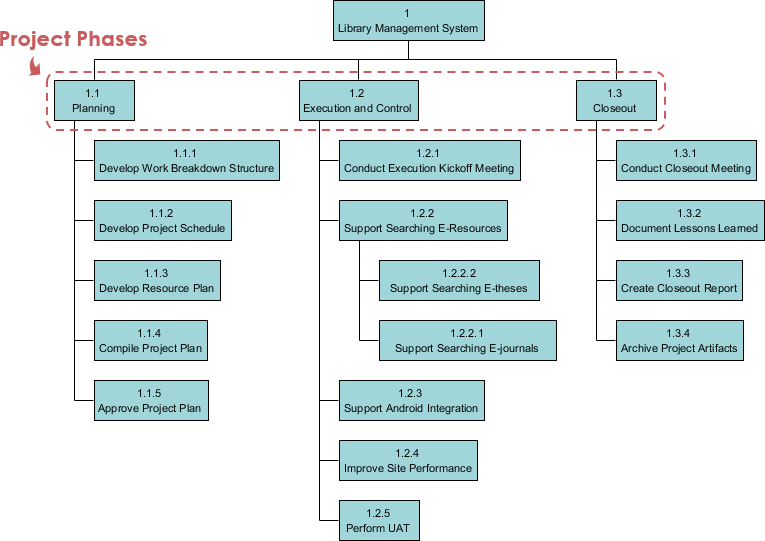
In the realm of project management, the Work Breakdown Structure (WBS) serves as the foundational skeleton of any successful initiative. It transforms a complex project scope into manageable, actionable components. Among the various methodologies available, the Phase-Based Structure stands out as one of the most intuitive and widely adopted approaches. This tutorial explores the architectural logic of phase-based WBS, visualizing how a project evolves from initial conception to final delivery.
The Philosophy of Phase-Based Structures
A phase-based WBS organizes the project hierarchy according to the chronological sequence of project activities. Unlike deliverable-based structures, which group work by physical components or final outputs, or responsibility-based structures, which group work by organizational units, the phase-based approach mirrors the natural lifecycle of the project.
When you look at the visual representation of a Library Management System project, you immediately see three distinct pillars:
- 1.1 Planning: The foundational stage where the roadmap is drawn.
- 1.2 Execution and Control: The operational heart where the actual work is performed and monitored.
- 1.3 Closeout: The concluding phase where the project is formally handed over and archived.
Deconstructing the Hierarchy
The diagram illustrates a classic top-down decomposition. The root node, 1 Library Management System, represents the total project scope. From this root, the structure branches into the primary phases.
1. The Planning Phase (1.1)
The first branch, labeled 1.1 Planning, encapsulates all preparatory activities. In this specific architecture, the WBS breaks down planning into granular sub-tasks:
- 1.1.1 Develop Work Breakdown Structure: Creating the plan for the plan.
- 1.1.2 Develop Project Schedule: Defining the timeline.
- 1.1.3 Develop Resource Plan: Allocating personnel and materials.
- 1.1.4 Compile Project Plan: Aggregating all subsidiary plans.
- 1.1.5 Approve Project Plan: The formal sign-off required before execution begins.
Notice how these tasks form a logical sequence. You cannot approve the project plan (1.1.5) until it is compiled (1.1.4), which requires a schedule (1.1.2) and resource allocation (1.1.3).
2. The Execution and Control Phase (1.2)
The largest branch of the tree, 1.2 Execution and Control, represents the bulk of the project’s effort. This phase is characterized by active development and ongoing management. The visual hierarchy reveals a specific flow of technical work:
- 1.2.1 Conduct Execution Kickoff Meeting: The formal start of the build phase.
- 1.2.2 Support Searching E-Resources: A unique sub-structure for a library system, breaking down into specific resource types like E-theses (1.2.2.2) and E-journals (1.2.2.1).
- 1.2.3 Support Android Integration: A specific deliverable or technical module.
- 1.2.4 Improve Site Performance: Optimization tasks.
- 1.2.5 Perform UAT: User Acceptance Testing, the final gate before delivery.
3. The Closeout Phase (1.3)
The final branch, 1.3 Closeout, is often the shortest but most critical for administrative closure. It ensures that the project leaves no loose ends:
- 1.3.1 Conduct Closeout Meeting: Reviewing the project with stakeholders.
- 1.3.2 Document Lessons Learned: Capturing institutional knowledge.
- 1.3.3 Create Closeout Report: Formal documentation of project success or variance.
- 1.3.4 Archive Project Artifacts: Storing all data for future reference.
Why Choose a Phase-Based Structure?
The primary advantage of this structure is its alignment with the project management lifecycle. It provides a clear visual narrative of the project’s progress. When a project manager looks at this WBS, they can immediately assess the status of the project by looking at which “phase” is currently active. It is particularly effective for service-based projects or software development lifecycles where the distinction between “planning,” “doing,” and “finishing” is rigid.
However, it is important to note that a phase-based structure might obscure the specific deliverables if the phases are defined too broadly. In the diagram above, the execution phase (1.2) is quite dense, suggesting that for very large projects, a hybrid approach (e.g., organizing by phase, but subdividing by major deliverable) might be necessary to maintain clarity.