
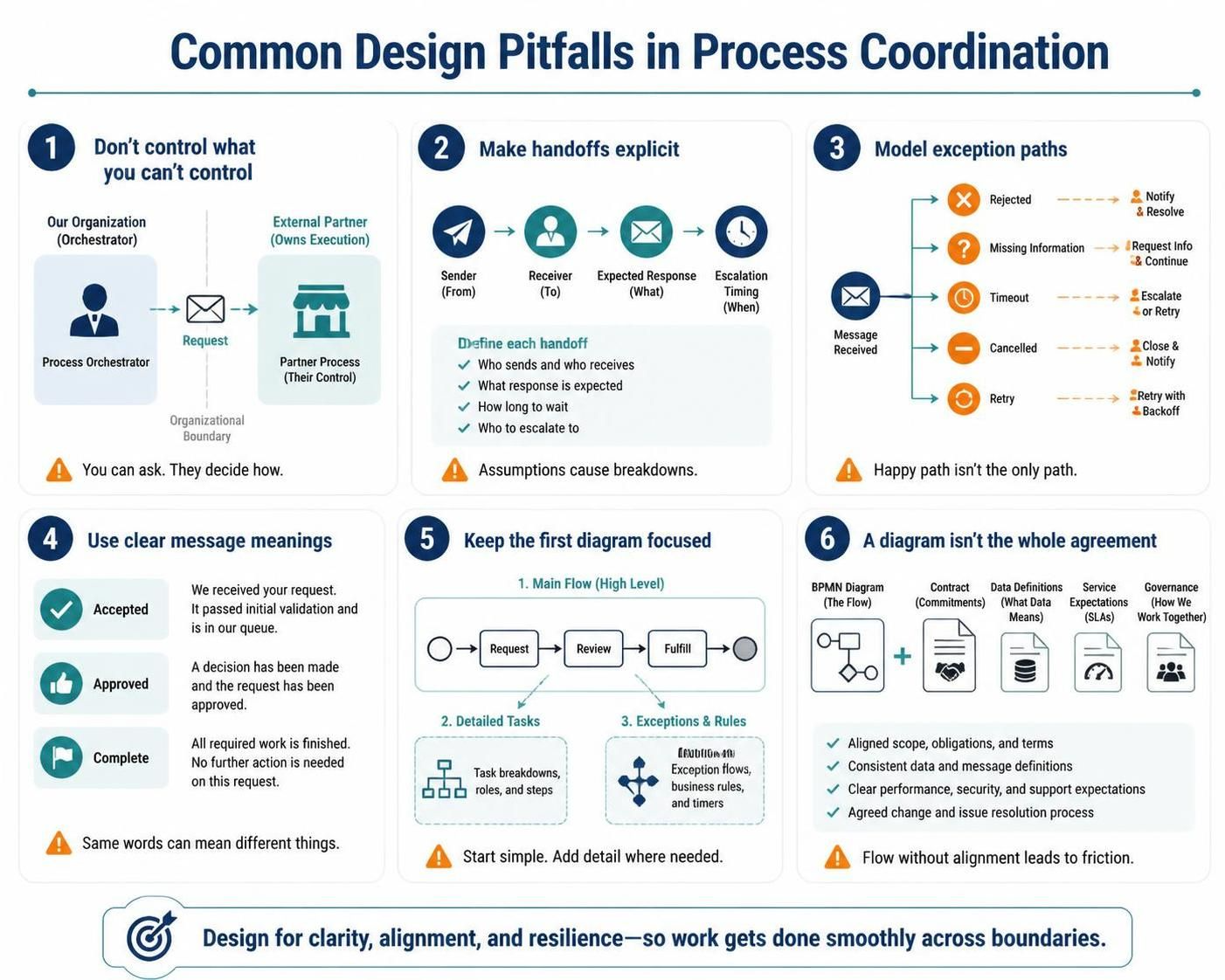
When orchestrating business processes that span across organizational boundaries—such as between a central controller and external partners—it is critical to design for clarity, alignment, and resilience. A well-structured process model not only defines the flow of work but also sets expectations for communication, responsibility, and error handling. This tutorial explores six common design pitfalls in process coordination and provides actionable guidance to avoid them, using principles aligned with BPMN best practices and supported by AI-assisted modeling tools like Visual Paradigm.
1. Don’t Control What You Can’t Control
One of the most frequent mistakes in cross-organizational process design is assuming that the orchestrator (e.g., your organization) can dictate how an external partner executes their part of the workflow. While you can send requests or monitor commitments, you do not own the partner’s internal execution logic.
Key Principle: Your role is to request, not to command. The external participant retains ownership of their own process execution.
To avoid overreach:
- Clearly define what you expect (e.g., a response within 24 hours).
- Avoid embedding assumptions about their internal steps.
- Use timeouts or escalation paths if no response is received.
2. Make Handoffs Explicit
Vague handoffs between systems or organizations are a leading cause of process breakdowns. A handoff is more than just sending a message—it’s a structured exchange with defined roles, expectations, and timing.
Define each handoff by answering:
- Who sends? (Sender identity)
- Who receives? (Receiver identity)
- What is the expected response? (Message type, data format)
- When must it happen? (Timeout, SLA)
- Who to escalate to? (Fallback contact or system)
Without these details, participants operate on assumptions, leading to delays, errors, or missed commitments.
3. Model Exception Paths
Many process diagrams only show the “happy path”—the ideal scenario where everything goes smoothly. But real-world processes are full of exceptions: rejections, missing data, timeouts, cancellations, and retries.
Common exception scenarios to model:
- Rejected: Notify sender and resolve the issue.
- Missing Information: Request clarification and continue after receipt.
- Timeout: Escalate to a supervisor or retry with backoff.
- Cancelled: Close the process and notify all parties.
- Retry: Implement exponential backoff or circuit breaker patterns.
Failing to model these paths creates fragile processes that break at the first sign of trouble.
4. Use Clear Message Meanings
Terms like “Accepted,” “Approved,” or “Complete” may seem intuitive, but they can mean different things to different organizations. Ambiguity in message semantics leads to misalignment and rework.
Standardize message definitions with examples:
- Accepted: “We received your request. It passed initial validation and is in our queue.”
- Approved: “A decision has been made and the request has been approved.”
- Complete: “All required work is finished. No further action is needed on this request.”
Always document the exact meaning of status codes or message types in your interface contracts or data dictionaries.
5. Keep the First Diagram Focused
It’s tempting to include every detail in your first process diagram—but this leads to clutter and confusion. Start with a high-level view that shows the main flow and major participants.
Recommended layered approach:
- Level 1: Main Flow (High Level) – Show major steps like Request → Review → Fulfill.
- Level 2: Detailed Tasks – Break down complex steps into subtasks, roles, and timers.
- Level 3: Exceptions & Rules – Model failure paths, business rules, and retry logic separately.
This “start simple, add detail where needed” strategy keeps your diagrams maintainable and understandable.
6. A Diagram Isn’t the Whole Agreement
A BPMN diagram clarifies responsibilities and interactions, but it cannot replace formal agreements. Cross-company processes require more than just a flowchart—they need contracts, data definitions, service expectations, and governance frameworks.
Essential components beyond the diagram:
- Contract (Commitments) – Legal or operational obligations.
- Data Definitions – What each data field means and how it’s formatted.
- Service Expectations (SLAs) – Performance, security, and support standards.
- Governance – How you work together, resolve issues, and manage changes.
Without these, even the most elegant diagram can lead to friction when reality doesn’t match the model.
Conclusion: Design for Clarity, Alignment, and Resilience
Successful cross-boundary process coordination requires more than just drawing boxes and arrows. It demands intentional design that anticipates ambiguity, defines clear expectations, and builds in resilience for the inevitable exceptions. By avoiding these six common pitfalls—and leveraging tools like Visual Paradigm with AI assistance—you can create process models that are not only accurate but also actionable, maintainable, and aligned across organizations.
Remember: The goal isn’t just to depict a process—it’s to enable smooth, reliable work across boundaries.