
The modern landscape of software architecture and business process modeling has shifted from isolated diagramming tools to integrated, intelligent ecosystems. Visual Paradigm represents this evolution by unifying artificial intelligence, cloud collaboration, and professional modeling capabilities into a single platform. This tutorial explores the four pillars of the Visual Paradigm ecosystem, detailing how to leverage AI for rapid ideation and how to seamlessly transition those ideas into complex, production-ready models.
The Four Pillars of the Visual Paradigm Ecosystem
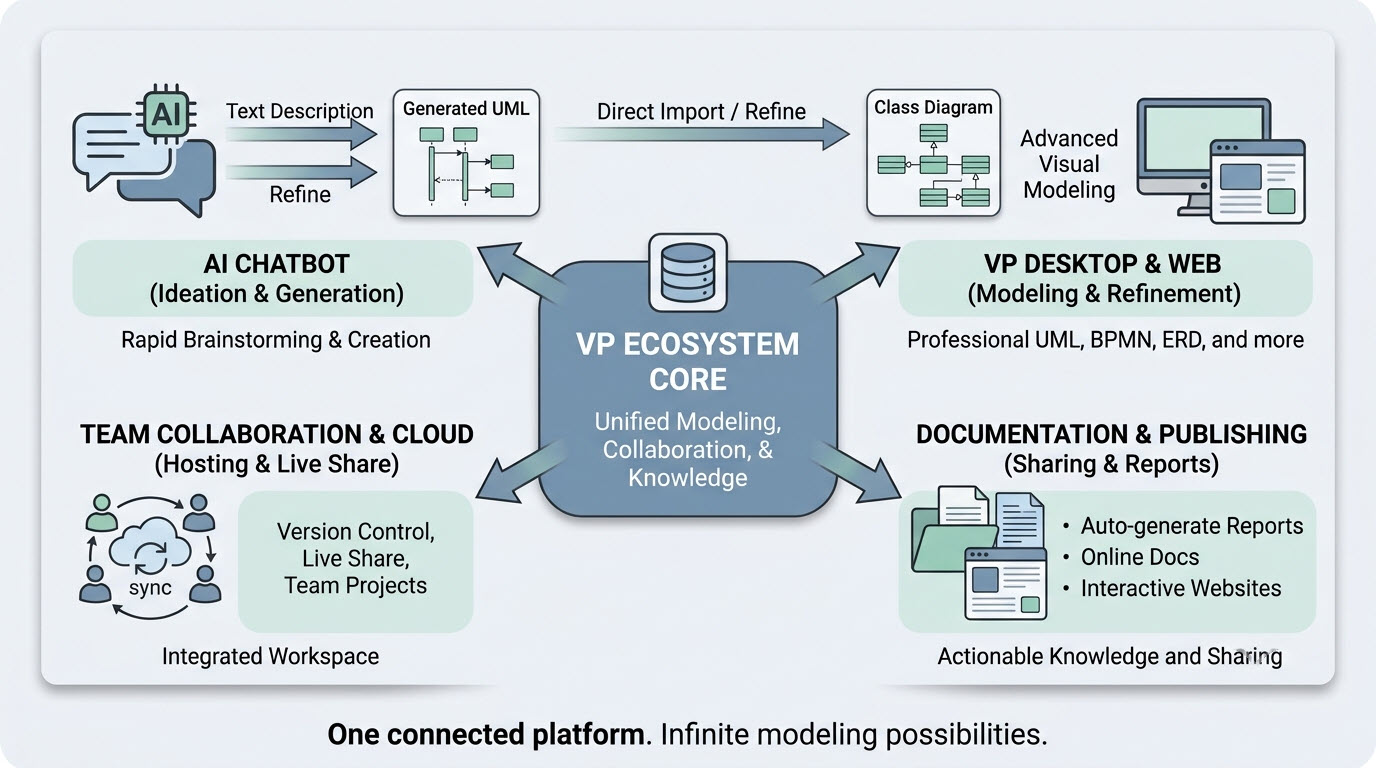
The architecture of Visual Paradigm is designed to support the entire software development lifecycle (SDLC). It is not merely a drawing tool but a comprehensive suite that handles everything from initial brainstorming to final documentation. The ecosystem is anchored by the VP Ecosystem Core, which manages unified modeling, collaboration, and knowledge management, connecting four distinct environments.
1. AI Chatbot: Ideation and Rapid Creation
The journey of a project often begins with a vague idea or a text description. The AI Chatbot serves as the entry point for this phase. It is designed for rapid brainstorming and creation, allowing users to bypass the technical overhead of setting up diagrams manually.
- Function: Users interact with the AI using natural language. Instead of dragging and dropping shapes, you describe the process or system logic.
- Workflow: The AI interprets your text description, generates a preliminary diagram (such as a UML class diagram or BPMN process), and allows you to refine the output through conversational feedback.
- Output: The result is a structural foundation (e.g., a generated UML model) that can be directly imported into the advanced modeling tools.
2. VP Desktop & Web: Modeling and Refinement
Once the initial concept is generated, it moves to the professional modeling environments: VP Desktop and VP Web. These are the workhorses of the ecosystem, where the “heavy lifting” of engineering takes place.
- Capabilities: These environments support professional-grade modeling for UML, BPMN, ERD, and SysML. They are designed for deep, offline modeling of complex projects.
- Refinement: This is where the “AI-generated” draft is polished. Users can apply strict geometric constraints, adjust swimlanes, and ensure compliance with industry standards like BPMN 2.0.
- Integration: The models created here are fully editable and serve as the source of truth for the project.
3. Team Collaboration & Cloud: Hosting and Live Share
Modern development is rarely a solitary activity. The Team Collaboration & Cloud module ensures that the modeling work is synchronized and accessible.
- Version Control: The system tracks changes, allowing teams to manage versions and revert to previous states if necessary.
- Live Share: Multiple users can work on the same project simultaneously, with a “sync” feature ensuring everyone sees the latest updates in real-time.
- Integrated Workspace: It creates a unified environment where developers, analysts, and stakeholders can view and interact with models without needing separate installations.
4. Documentation & Publishing: Sharing and Reports
The final pillar focuses on the output. A model is only valuable if it is understood. This environment transforms technical diagrams into actionable knowledge.
- Auto-generate Reports: The system can automatically compile documentation based on the models created, saving hours of manual writing.
- Online Docs & Interactive Websites: Models can be published as interactive web pages, allowing non-technical stakeholders to explore the process logic without needing the software installed.
Technical Workflow: From Text to Production Model
Understanding the flow of data within this ecosystem is crucial for effective modeling. The process typically follows a linear progression from abstract text to concrete visual logic.
- Input: A user provides a text description to the AI Chatbot.
- Generation: The AI parses the text, extracting semantic entities (pools, lanes, classes) and relationships.
- Refinement: The user refines the generated UML or BPMN diagram via the chat interface.
- Import: The refined model is imported into VP Desktop or VP Web.
- Optimization: The user applies advanced formatting, layout rules, and validation checks.
- Collaboration: The model is pushed to the cloud for team review.
- Publication: Final reports and interactive documentation are generated for stakeholders.
Conclusion
The Visual Paradigm ecosystem effectively bridges the gap between business strategy and technical implementation. By integrating AI-driven generation with professional-grade modeling tools and robust cloud collaboration, it streamlines the path from a simple text idea to a complex, production-ready architecture. Whether you are defining a business process or designing a software system, this unified platform provides the necessary tools for efficiency and precision.