
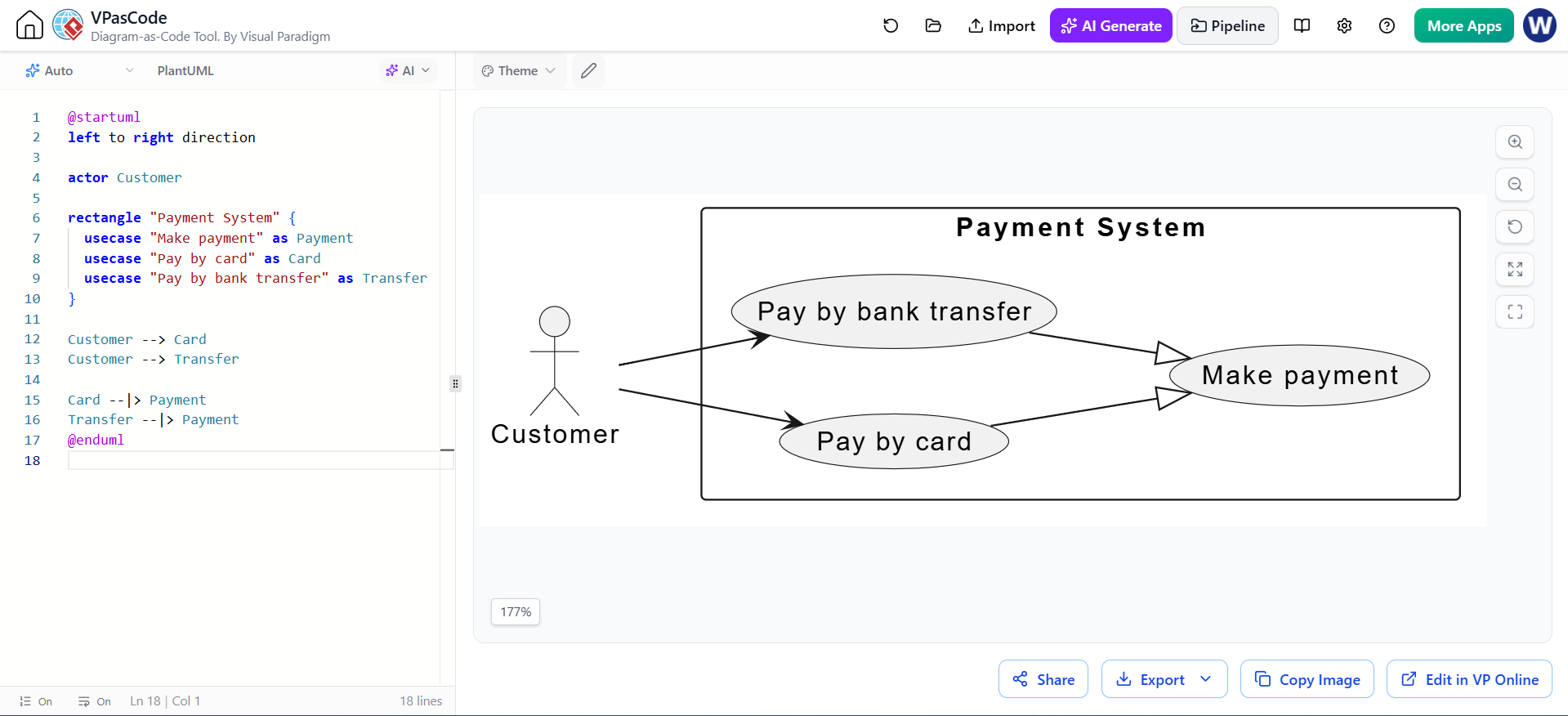
In the realm of software engineering, clarity in requirements is paramount. Use Case Diagrams are the industry-standard tool for capturing functional requirements, visualizing how users (actors) interact with a system. However, a common pitfall in modeling is the clutter of specific actions that should logically belong to a broader category. This is where Generalization becomes a critical architectural pattern.
This tutorial demonstrates how to leverage VPasCode—the Diagram-as-Code feature in Visual Paradigm—to efficiently model complex payment scenarios using Use Case Generalization. We will move from a messy list of actions to a clean, hierarchical model where specific payment methods inherit the core functionality of a general “Make Payment” use case.
Understanding the Architecture: Generalization vs. Association
Before diving into the code, it is essential to understand the semantic difference between a standard association and generalization in UML.
- Association (The “Uses” Relationship): This connects an Actor to a Use Case, indicating that the Actor initiates that specific process.
- Generalization (The “Is-a” Relationship): This represents a hierarchy. If “Pay by Card” is a generalization of “Make Payment,” it means “Pay by Card” is a specialized type of “Make Payment.” It inherits the common behavior but adds specific details.
In our context, we have a broad goal: Make Payment. We also have specific methods to achieve this: Pay by Card and Pay by Bank Transfer. Instead of duplicating logic, we define the specific methods as specialized versions of the general goal.
Step-by-Step: Modeling the Payment System
We will construct this diagram using VPasCode syntax. This approach allows for version control, rapid prototyping, and AI-assisted generation.
1. Setting the Stage: Direction and Actors
First, we define the layout and the primary user. In VPasCode, the @startuml directive initiates the diagram. We specify left to right direction to organize the flow logically.
@startuml left to right direction
actor Customer
2. Encapsulating Logic within a Boundary
Real-world systems are often modular. To represent the system boundary, we use the rectangle keyword. This visually groups the use cases under the “Payment System” label, distinguishing internal logic from external actors.
rectangle "Payment System" {
    usecase "Make payment" as Payment
    usecase "Pay by card" as Card
    usecase "Pay by bank transfer" as Transfer
}
3. Defining Relationships
Now comes the core logic. We must define how the Customer interacts with the system and how the specific payment methods relate to the general goal.
- Actor Association: The Customer interacts directly with the specific methods.
Customer --> Card Customer --> Transfer - Generalization: The hollow triangle arrow (
--|>) points from the specialized use case to the general one. This indicates that “Card” and “Transfer” are specialized forms of “Payment.”Card --|> Payment Transfer --|> Payment
Complete VPasCode Implementation
Below is the complete, copy-pasteable code snippet. You can input this directly into the Visual Paradigm VPasCode Editor to generate the diagram instantly.
@startuml left to right direction
actor Customer
rectangle "Payment System" {
usecase "Make payment" as Payment
usecase "Pay by card" as Card
usecase "Pay by bank transfer" as Transfer
}
Customer --> Card
Customer --> Transfer
Card --|> Payment
Transfer --|> Payment
@endumlWhen rendered, this code produces a clean diagram where the “Customer” connects to the specific actions, and the specific actions converge into the general “Make Payment” use case via generalization arrows. This visual hierarchy immediately communicates to stakeholders that the specific payment methods are interchangeable ways to achieve the primary goal.
When to Use Generalization
A common question in modeling is: “Should I use Generalization or just list everything?” Generalization is best used when the specialized use cases share a general goal but have meaningful differences in their internal logic (e.g., different validation rules for a card vs. a bank transfer). If the variations are merely conditional steps (e.g., “Pay by Cash” vs. “Pay by Card” where the flow is identical except for one step), an <<extend>> relationship or a written description might be clearer.