


Imagine transforming a complex business challenge into a clear, actionable roadmap in minutes. The AI-Powered SWOT-TOWS Business Analysis Tool from Visual Paradigm makes this a reality. This powerful application guides you through a comprehensive strategic assessment, seamlessly integrating the proven SWOT framework with the action-oriented TOWS Matrix. As shown in the first image, the process begins with a simple input: your business name and industry context. In this example, a user inputs “HealthBridge Clinics” and “Healthcare Services & Outpatient Care,” instantly setting the stage for an intelligent analysis. The tool then leverages AI to generate a complete SWOT analysis, moving from theoretical concepts to a tangible strategic plan. This is not just a tool; it’s a strategic partner that accelerates your decision-making. Let’s explore how this innovative software turns a daunting task into a streamlined, efficient process.
Quick Summary: Key Benefits of the AI-Powered SWOT-TOWS Tool
-
AI-Driven Efficiency: Generate a full SWOT and TOWS analysis in minutes by simply providing your business context.
-
Structured Workflow: Follow a guided 6-step process for a thorough and consistent analysis.
-
Actionable Insights: Move beyond identification to formulate concrete strategies using the TOWS Matrix.
-
Professional Output: Produce a polished, shareable report for team discussions and leadership presentations.
-
Complete Privacy: Your sensitive business data is saved locally to your computer, ensuring confidentiality.
From Input to Insight: A Step-by-Step Walkthrough
The journey begins with the AI-Powered SWOT-TOWS Business Analysis Tool at its initial screen.
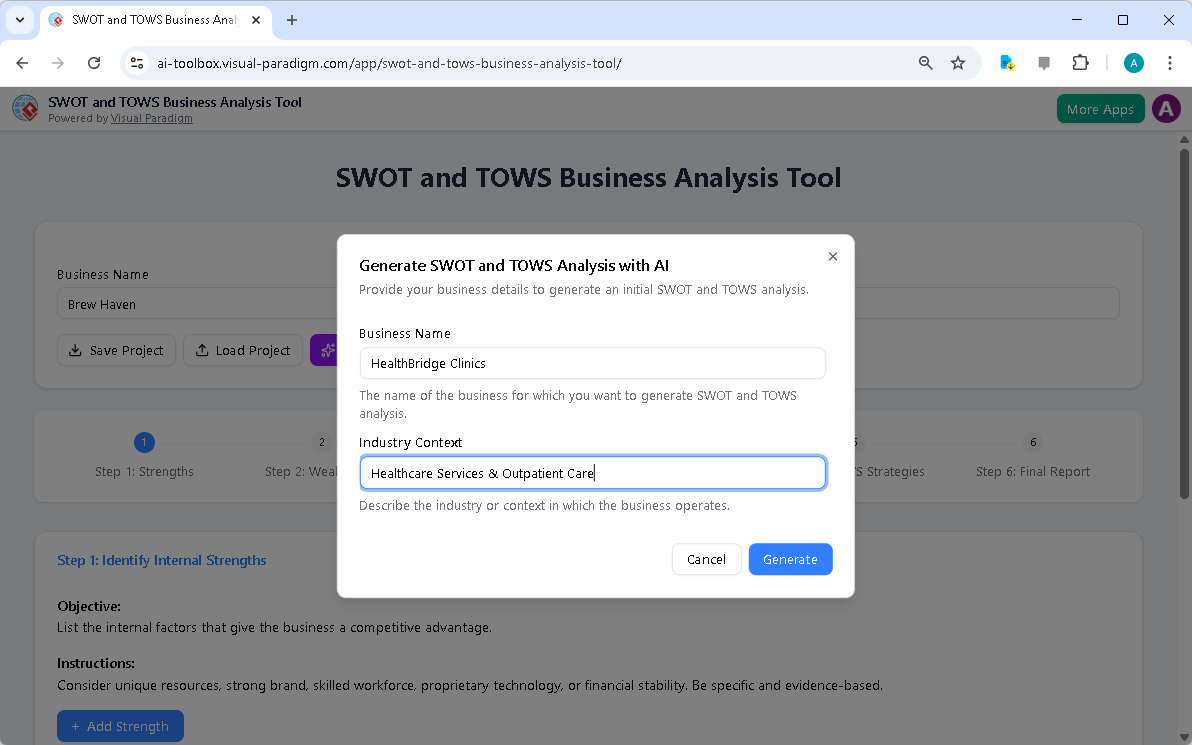
The user is prompted to enter their “Business Name” and “Industry Context.” This initial input is crucial, as it provides the AI with the necessary context to generate relevant and plausible factors. Once the business details are entered, the user clicks “Generate with AI,” initiating the first phase of the analysis.
The process then progresses to Step 1: Identify Internal Strengths:
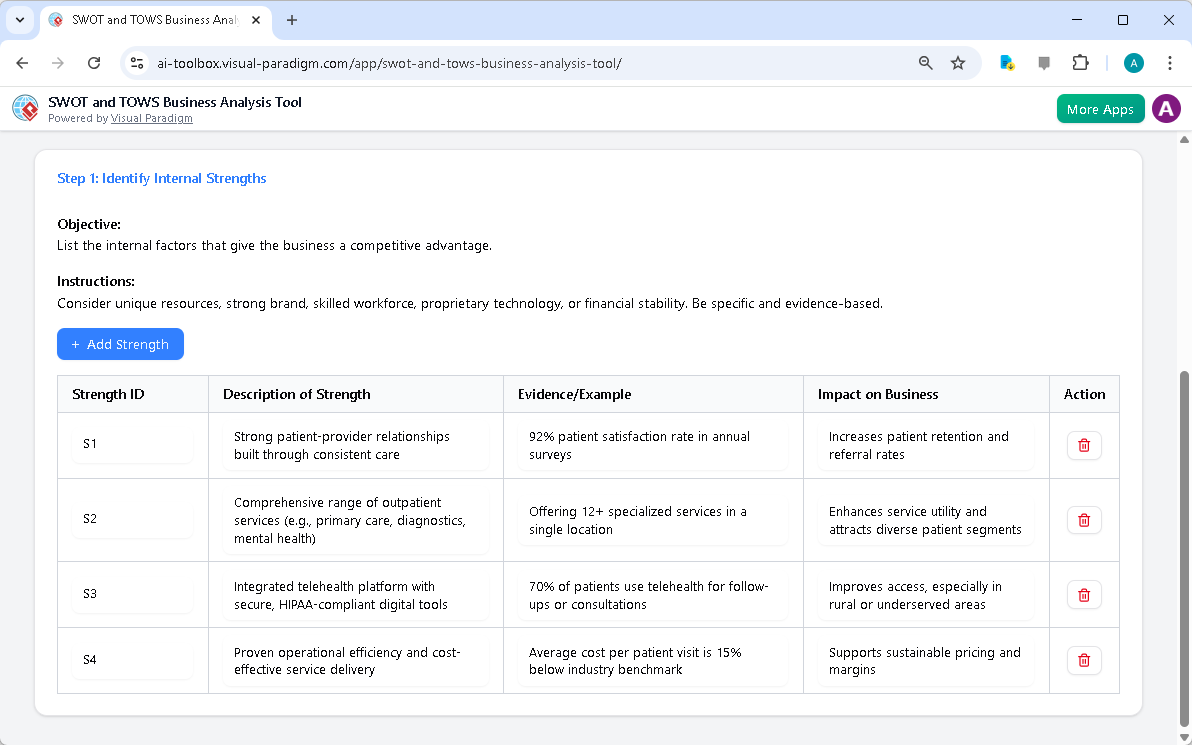
The tool presents a dynamic table where the AI has already populated the “Strength ID,” “Description of Strength,” “Evidence/Example,” and “Impact on Business” columns. For HealthBridge Clinics, the AI has identified strengths such as “Strong patient-provider relationships” and a “Comprehensive range of outpatient services.” This AI-generated output serves as a powerful starting point, providing a comprehensive first draft that the user can then validate and refine with their own expert knowledge.
Next, the analysis moves to Step 2: Identify Internal Weaknesses:
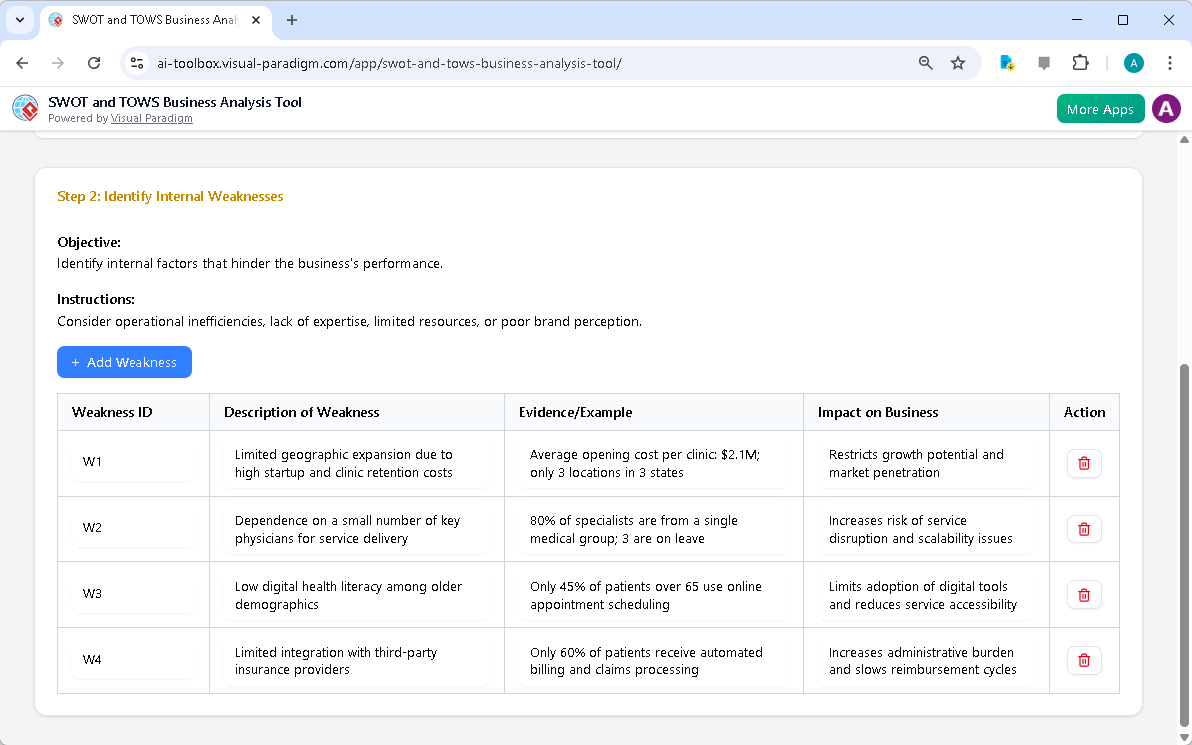
Here, the tool prompts the user to consider internal factors that hinder performance. The AI has populated the table with weaknesses like “Limited geographic expansion” and “Dependence on a small number of key physicians.” This step is critical for a realistic assessment, ensuring that the strategic plan is not built on a foundation of unacknowledged vulnerabilities.
With the internal factors established, the focus shifts to the external environment in Step 3: Identify External Opportunities:
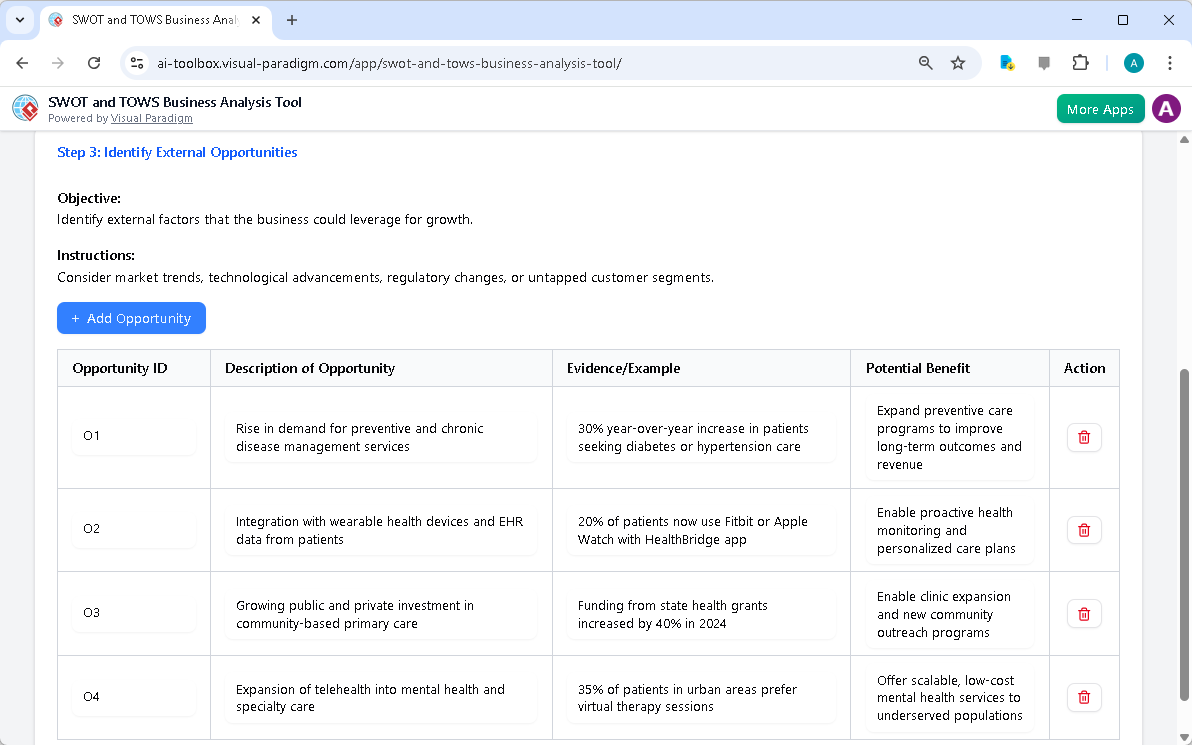
The AI suggests opportunities such as the “Rise in demand for preventive and chronic disease management services” and “Integration with wearable health devices.” These external factors are essential for identifying potential growth avenues and market trends that the business can capitalize on.
Step 4: Identify External Threats:
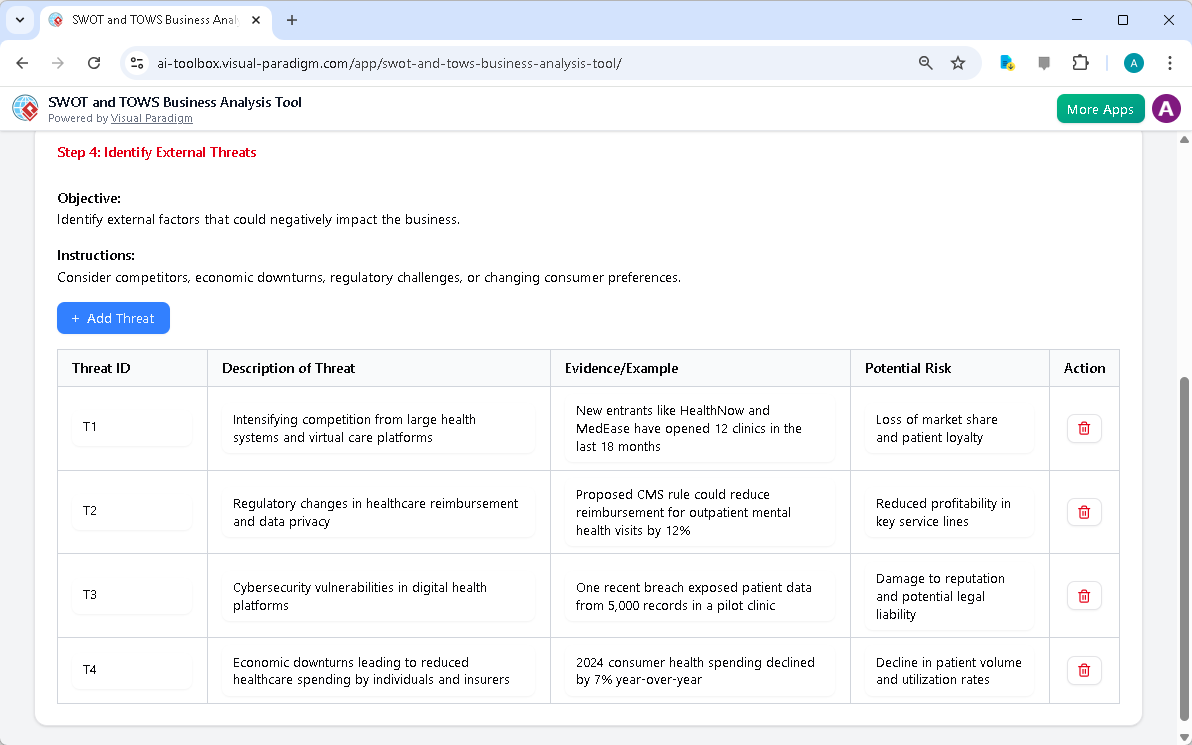
This completes the SWOT analysis. The tool highlights threats like “Intensifying competition from large health systems” and “Cybersecurity vulnerabilities.” This step ensures that the strategic plan is not only forward-looking but also defensive, preparing the organization to mitigate risks.
After completing the foundational SWOT analysis, the tool guides the user to Step 5: Conduct TOWS Analysis, as shown in:
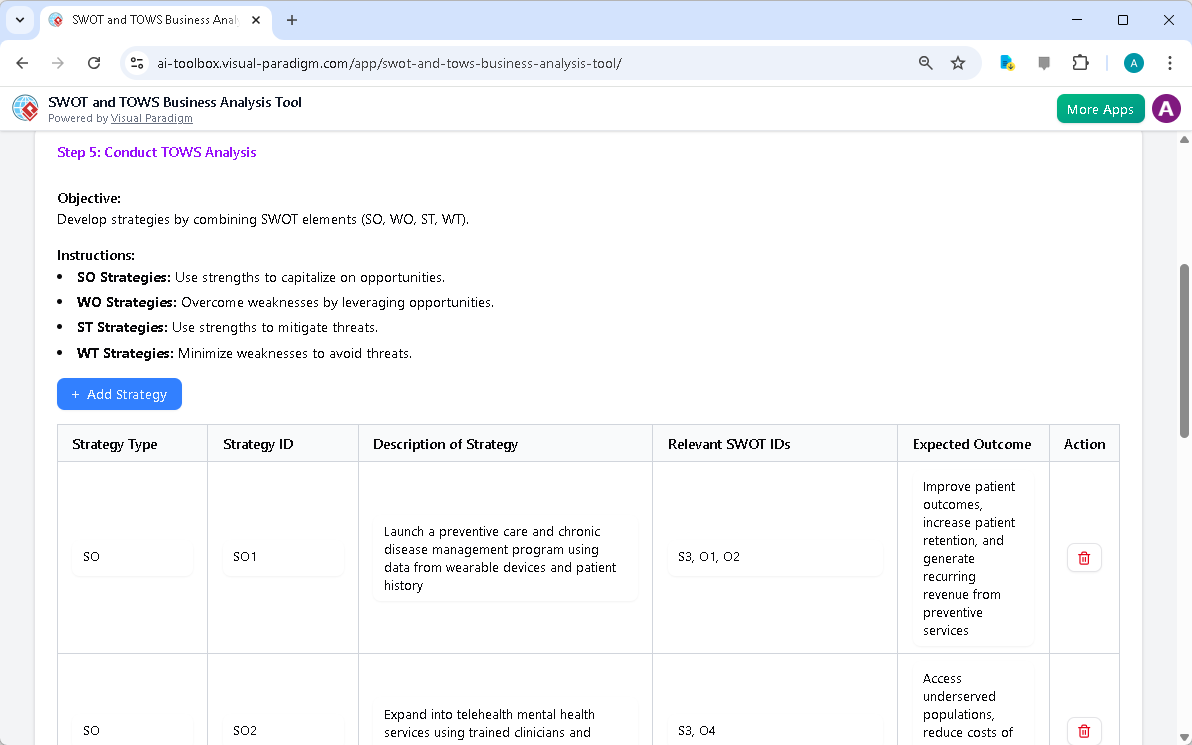
This is where the analysis transforms into actionable strategy. The TOWS Matrix combines the internal and external factors to generate specific strategies. For instance, an “SO Strategy” might be to “Launch a preventive care and chronic disease management program using data from wearable devices and patient history,” leveraging a strength (telehealth platform) to capitalize on an opportunity (rising demand). The AI provides initial strategy suggestions, which the user can then refine.
The culmination of this process is the Final Report, displayed in
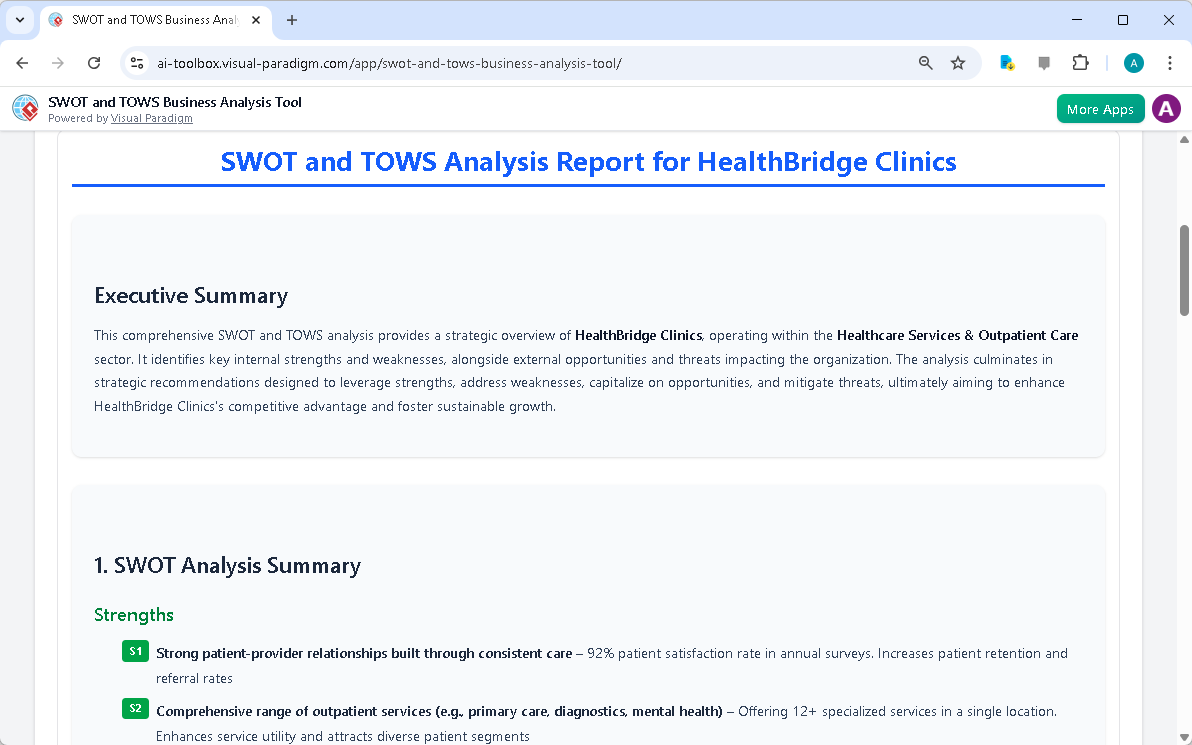
. The tool consolidates all the data from the previous steps into a professional, easy-to-read document. The report begins with an executive summary, followed by a detailed SWOT analysis summary. This final output is a powerful tool for communication, allowing the user to present their strategic findings to stakeholders with confidence. The entire process, from a simple input to a comprehensive report, is designed for efficiency and impact.
Why This AI-Powered Tool is a Game-Changer for Strategic Planning
Traditional SWOT analysis can be a time-consuming and often subjective process. The AI-Powered SWOT-TOWS Business Analysis Tool revolutionizes this by providing a structured, intelligent workflow. The AI-generated analysis acts as a powerful catalyst, eliminating the initial hurdle of brainstorming and providing a robust starting point for strategic discussions. This allows business strategists, entrepreneurs, and consultants to focus their energy on the critical tasks of validation, refinement, and strategic interpretation, rather than on data collection and initial categorization.
Furthermore, the tool’s ability to generate a professional report at the end is invaluable. It transforms a complex analytical exercise into a clear, shareable document that can be used for presentations, team alignment, and executive decision-making. The structured 6-step workflow ensures that no critical aspect of the analysis is overlooked, making the process both thorough and reproducible. For professionals in the healthcare sector, like the user of HealthBridge Clinics, this tool provides a clear, data-driven path to navigate the complexities of the industry and drive sustainable growth.
Accelerate Your Strategic Planning with Visual Paradigm
Don’t let the complexity of strategic analysis hold you back. The AI-Powered SWOT-TOWS Business Analysis Tool from Visual Paradigm offers a powerful solution for anyone looking to gain a competitive edge. From the initial AI generation to the final professional report, this tool streamlines the entire process, making strategic planning faster, more efficient, and more effective. It’s the perfect tool for business strategists, entrepreneurs, and consultants who need to make informed decisions quickly.
Ready to transform your strategic planning? Try the AI-Powered SWOT-TOWS Business Analysis Tool today and experience the power of AI-driven strategic insight.
Related Links
-
AI-Powered SWOT and TOWS Business Analysis Tool: This tool leverages artificial intelligence to assist users in conducting SWOT and TOWS analyses for strategic business planning.
-
SWOT Analysis: A Definitive Guide to AI-Powered Strategic Planning: Learn what SWOT Analysis is and see how AI helps you generate deeper insights, create TOWS strategies, and turn strategic planning into a fast, data-driven, and continuous process.
-
Free AI SWOT & TOWS Analysis Tool for Strategic Planning …: Move from analysis to action with our free AI SWOT & TOWS analysis tool. A step-by-step guide to identify your strengths and weaknesses, and formulate powerful strategies.
-
How SWOT-TOWS Analysis Works in Business: Stop creating static SWOT lists. This guide explains how our tool uses the powerful TOWS matrix to bridge the gap between analysis and action.
-
SWOT-TOWS Business Analysis Archives – Visual Paradigm AI: A SWOT analysis is a powerful tool, but its effectiveness hinges on the accuracy of your external scan. Simply listing opportunities and threats isn’t …
-
The Core Difference: SWOT vs. TOWS – Visual Paradigm AI: November 6, 2025 – Its purpose is to take the descriptive data from your SWOT analysis and transform it into a set of actionable strategies . It does this by pairing up the four SWOT categories to formulate four types of strategies: SO (Strengths-Opportunities): …